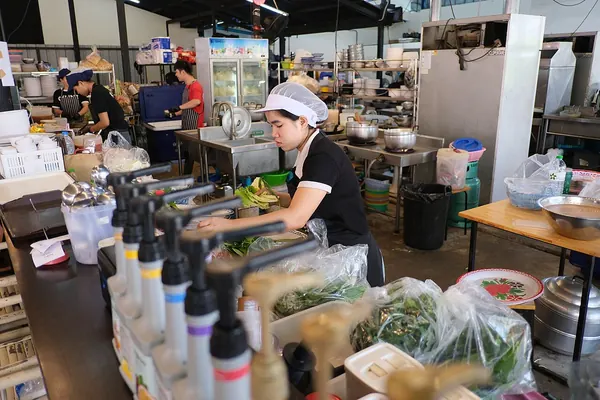
What this section covers: Cleaning versus sanitizing; the 3-compartment sink, Sanitizer concentration, temperature and contact time, Wiping cloths, storage of clean items, Pests and poisonous or toxic materials.
6 free practice questions
Click an answer: you see at once whether it is right, with the explanation.
-
Question 1What is the difference between cleaning and sanitizing?
Show the answer
Answer: B — Cleaning removes dirt and food; sanitizing reduces germs to safe levels.
A surface must first be cleaned to remove food and soil; then sanitizing, with heat or a chemical, reduces the number of germs to a safe level. Sanitizer does not work well on a dirty surface.
Checked against: FDA Food Code 2022, 1-201.10 Definitions, Sanitization
-
Question 2Where should a wet wiping cloth used on counters be kept between uses?
Show the answer
Answer: D — In a sanitizer solution at the correct concentration.
Wet cloths used for wiping counters are held between uses in a chemical sanitizer solution at the concentration the Food Code requires, and laundered daily.
Checked against: FDA Food Code 2022, 3-304.14 Wiping Cloths, Use Limitation
-
Question 3How can you tell whether a chemical sanitizer solution is at the right strength?
Show the answer
Answer: D — Use a test kit or test strips made for that sanitizer.
A test kit is used to measure the concentration of the sanitizer, following the manufacturer's label. Too weak will not sanitize; too strong can leave a chemical hazard.
Checked against: FDA Food Code 2022, 4-302.14 Sanitizing Solutions, Testing Devices
-
Question 4After sanitizing, how should dishes and utensils be dried?
Show the answer
Answer: D — Air-dried.
Cleaned and sanitized items are air-dried. Towels and cloths can put germs back on the clean surfaces.
Checked against: FDA Food Code 2022, 4-901.11 Equipment and Utensils, Air-Drying Required
-
Question 5You see mouse droppings in the dry storage room. What should you do?
Show the answer
Answer: D — Tell the person in charge right away.
Signs of rodents or insects must be reported so the operation can control the pests, for example with traps or other approved methods, and check whether food was contaminated. Pesticides may only be used as their label allows, and restricted-use pesticides only by a certified applicator.
Checked against: FDA Food Code 2022, 6-501.111 Controlling Pests; 7-202.12 Conditions of Use
-
Question 6A slicer in a kitchen kept at normal room temperature is used all day to slice deli meats. At least how often must it be cleaned and sanitized?
Show the answer
Answer: A — Every 4 hours.
Equipment in constant use with TCS food must be cleaned throughout the day at least every 4 hours, unless an exception in the Food Code applies, such as equipment kept in a cold room.
Checked against: FDA Food Code 2022, 4-602.11 Equipment Food-Contact Surfaces and Utensils, Frequency
Secure payment by Stripe · Card, Apple Pay · One-off, instant access
Instant access to your online tests and PDF after payment · Terms of sale
Cleaning, sanitizing and pests
Cleaning removes food and dirt; sanitizing then reduces germs to a safe level. A surface has to be clean before it can be sanitized.
The 3-compartment sink
- Scrape or pre-rinse food off the items.
- Wash in detergent solution.
- Rinse in clean water.
- Sanitize: hot water at 171°F or above for at least 30 seconds (Food Code 4-501.111, 4-703.11), or a chemical sanitizer at the right concentration, temperature and contact time.
- Air-dry (4-901.11). Never towel-dry.
Chemical sanitizers in the Food Code
| Sanitizer | Food Code 2022 rule (4-501.114) |
|---|---|
| Chlorine | Concentration, temperature and pH from the Food Code chart, for example 50 to 99 ppm at 75°F (pH 8 or less) or 100°F (pH 10 or less); contact time usually at least 10 seconds |
| Iodine | 12.5 to 25 ppm, at least 68°F, pH 5.0 or less |
| Quaternary ammonium | Concentration on the label, at least 75°F, water hardness 500 ppm or less |
Use a test kit to check strength (4-302.14). Wet wiping cloths for counters are kept in sanitizer between uses (3-304.14). Surfaces used with TCS food all day are cleaned at least every 4 hours (4-602.11).
Pests
Keep doors closed, garbage covered and food off the floor. Report droppings or insects to the person in charge; pesticides are applied according to the label, and restricted-use products only by a certified applicator (7-202.12). Source: FDA Food Code 2022.
More Food Handler Test practice
Full free Food Handler Test practice test
Mixed questions, test format and official rules.
Food safety basics: food handler practice questions
6 free questions
Personal hygiene practice questions for food handlers
6 free questions
Cross-contamination and allergens: food handler quiz
6 free questions
Time and temperature practice questions
6 free questions
ServSafe is a registered trademark of the National Restaurant Association. passmock is not affiliated with or endorsed by the National Restaurant Association, ANAB/ANSI, the FDA, any state health department or any food handler training provider. Original practice questions, not questions from the real test.
Short on time? A professional can help
Prefer to work with a professional? A tutor, a prep course or a driving school: we can pass your request to up to 3 partners. Free, no obligation; passmock does not teach. How to choose.