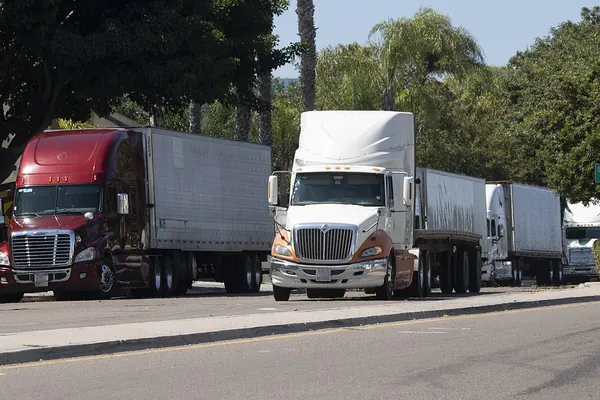
Where the pre-trip fits in the CDL test
The CDL skills test has three parts, and federal rules fix the order: pre-trip inspection, basic vehicle control, then on-road driving. If you fail one part, you cannot go on to the next. Parts you passed only stay valid while your first learner's permit is valid; if the CLP is renewed, all three must be retaken.
California now calls it the vehicle inspection test (formerly pre-trip). Its handbook says it takes approximately 40 minutes, there is no extra fee to retake it on the same application, and you get a total of 3 attempts at the three skills tests.
You can only take the skills test after holding your permit for 14 days and, for a first Class A or B license, after entry-level driver training. Our CDL practice test page covers the permit side.
What the examiner wants: name, point, explain
Federal rules say you must be able to identify each safety-related part and explain what needs to be inspected, covering the engine compartment, cab and engine start, steering, suspension, brakes, wheels, side and rear of the vehicle, and the special features of a tractor-trailer, school bus or coach.
The state manuals describe the test the same way:
- You walk around the vehicle, point to or touch each item and explain what you are checking and why (New York, Section 11).
- New York says you will not have to crawl under the hood or under the vehicle (California says you may have to raise the hood or open the engine compartment door). The examiner tells you which areas to inspect; it can be the whole vehicle or only a portion.
- The test must be done in English, without an interpreter (49 CFR 383.133). In California, a third offense of communicating in another language on the same test date ends the test as an automatic failure.
- A vehicle with marked or labeled components cannot be used (California handbook).
- In California, the brake lights, emergency flashers, turn signals and horn must work, or the skills and road tests are postponed.
A good explanation names the part, says what "good" looks like and what defect you are looking for. For example: "Brake hoses and lines: I'm looking for cracks, wear or leaks, including at the couplings." Saying "it looks fine" does not show the examiner what you checked.
Can you use notes?
FMCSA says your state may allow its "training aid" to help you remember the checklist. California allows only the vehicle inspection guide printed at the end of Section 11 of its handbook, with nothing written on it; using anything else marks the skills test as failed (California handbook).
The checklist, part by part
The items below come from New York's Section 11, which follows the national model (CDL-10, Section 11). The numbers are the ones you are expected to say out loud.
| Area | What to check | Numbers to know |
|---|---|---|
| Engine compartment (engine off) | Leaks and hoses, oil level, coolant, power steering fluid, belts (power steering, water pump, alternator, air compressor) | Belts: no more than 3/4 inch of play at the center |
| Cab check and engine start | Oil pressure, temperature, air and voltmeter gauges; mirrors and windshield; emergency equipment; steering play; wipers; lights; horn; heater and defroster; parking brake; brake check; seat belt | Steering play no more than 10 degrees (about 2 inches on a 20-inch wheel); air built to governor cut-out, roughly 120-140 psi |
| Emergency equipment | Spare fuses, warning devices, fire extinguisher | 3 red reflective triangles (or 6 fusees or 3 liquid flares); properly charged and rated extinguisher |
| Hydraulic brakes | Pump the pedal, then hold it | Pump 3 times, hold 5 seconds: the pedal should not move |
| Steering and suspension | Steering box and linkage, springs, mounts, shock absorbers | No missing nuts, bolts or cotter keys; check every axle |
| Brakes | Slack adjusters and pushrods, brake chambers, hoses, drums, linings | Manual slack adjuster: pushrod should not move more than 1 inch (brakes released) when pulled by hand |
| Wheels | Rims, tires, hub seals, lug nuts, spacers | Tread at least 4/32 inch on steering tires, 2/32 on others; check inflation with a gauge |
| Side and rear | Doors, mirrors, fuel tank, battery, drive shaft, exhaust, frame, splash guards, cargo doors and lifts | |
| Coupling (Class A) | Air and electric lines, catwalk, fifth wheel mounting, locking jaws around the kingpin, release arm, apron and gap | No gap between trailer and fifth wheel |
Two details catch people out. New York says you get no credit for kicking tires to check inflation: use a tire gauge. And if a component is not belt-driven, you must tell the examiner and still check that it works, is not leaking and is mounted securely.
The air brake check
On a vehicle with air brakes, the in-cab air brake check is pass or fail on its own. New York says failing to perform all three parts correctly is an automatic failure of the vehicle inspection test, and California treats every required item in the same way if it is not demonstrated and its limits are not said aloud (California handbook, 5.3.3). The steps and limits are in our CDL air brakes test guide.
Learn it as the 7-step method
Both the California and New York manuals teach the inspection as a fixed sequence, so you learn every step and are less likely to forget one (California handbook, 2.1.5; step names from New York, Section 2):
- Vehicle overview (including the last inspection report)
- Check the engine compartment
- Start the engine and inspect inside the cab
- Turn off the engine and check the lights
- Do a walk-around inspection
- Check the signal lights
- Start the engine and check the brake system
Practice it in the same order on a real truck until you can say each line without the guide. Our general knowledge practice questions include inspection questions, because the written test covers this material too.
The inspection rules after you are licensed
The test exists because inspections are a legal duty on every working day:
- Before driving, you must be satisfied the vehicle is in safe operating condition, review the last driver vehicle inspection report if it listed defects, and sign it to acknowledge that repairs were certified (49 CFR 396.13).
- You may not drive unless the service brakes and trailer brake connections, parking brake, steering, lights and reflectors, tires, horn, wipers, mirrors, coupling devices, wheels and rims, and emergency equipment are in good working order (49 CFR 392.7).
- At the end of each day's work, the report covers the same list for each vehicle you drove, and you must prepare and sign it when a defect affecting safety was found by or reported to you; no report is required if none was (49 CFR 396.11, which exempts some operations, such as a carrier running only one CMV). The carrier must fix safety defects before the vehicle runs again and keep reports for three months.
- Cargo: truck drivers must check the load and its securement within the first 50 miles, then again at each change of duty status, or after 3 hours or 150 miles of driving, whichever comes first (49 CFR 392.9).
Getting ready
Read Section 11 of your state's manual with the truck you will test in. Note which items your vehicle has (fifth wheel or pintle hook, air or hydraulic brakes, belt-driven or not), because you inspect your own vehicle's features. Then rehearse aloud, part by part, with someone holding the list. The CDL practice pack covers the written tests only; the skills test has to be practiced on a vehicle.
Sources
- 49 CFR 383.113, Required skills — eCFR (checked October 3, 2026)
- 49 CFR 383.133, Test methods — eCFR (checked October 3, 2026)
- New York State Commercial Driver's Manual (CDL-10), Sections 11-13 — NYS DMV (checked October 3, 2026)
- New York State Commercial Driver's Manual (CDL-10), Section 2 — NYS DMV (checked October 3, 2026)
- California Commercial Driver Handbook — California DMV (checked October 3, 2026)
- How do I get a Commercial Driver's License? — FMCSA (checked October 3, 2026)
- 49 CFR 392.7, Equipment, inspection and use — eCFR (checked October 3, 2026)
- 49 CFR 392.9, Inspection of cargo and securement devices — eCFR (checked October 3, 2026)
- 49 CFR 396.11, Driver vehicle inspection reports — eCFR (checked October 3, 2026)
- 49 CFR 396.13, Driver inspection — eCFR (checked October 3, 2026)
passmock is an independent practice service. It is not affiliated with or endorsed by the Federal Motor Carrier Safety Administration (FMCSA), the U.S. Department of Transportation, the American Association of Motor Vehicle Administrators (AAMVA) or any state DMV, DPS or driver licensing agency. Our questions are original practice questions written from the official state CDL manuals and federal regulations; they are not taken from any state's test.
Short on time? A professional can help
Prefer to work with a professional? A tutor, a prep course or a driving school: we can pass your request to up to 3 partners. Free, no obligation; passmock does not teach. How to choose.