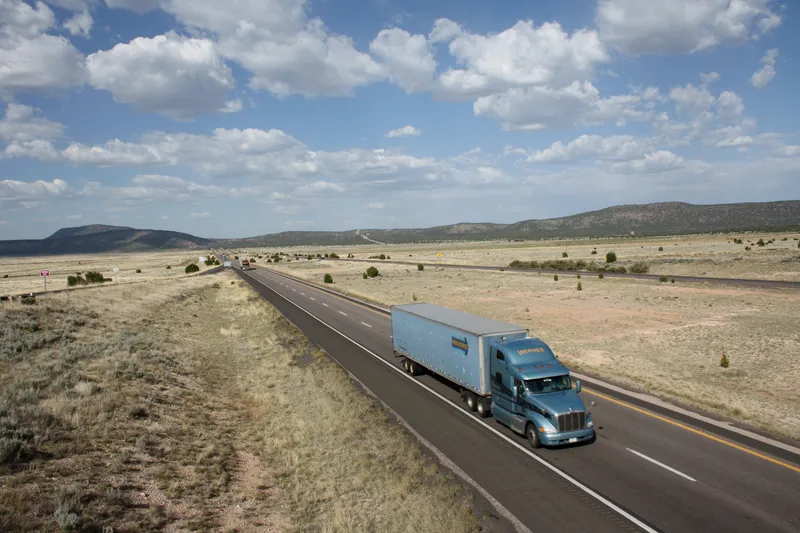
What this section covers: CDL classes, CLP rules and disqualifications, Vehicle inspection, Basic control, shifting and backing, Seeing, communicating and managing space, Controlling speed and seeing hazards, Distracted, aggressive and fatigued driving, Night, fog, winter and hot-weather driving, Railroad-highway crossings and mountain driving, Driving emergencies, skids, ABS, crashes and fires, Alcohol, other drugs and illness, Hazardous materials rules for all drivers, Transporting cargo safely (inspection, weight and balance, securement).
15 free practice questions
Click an answer: you see at once whether it is right, with the explanation.
-
Question 1A truck driver is hauling cargo. When must the cargo securement be inspected?
Show the answer
Answer: B — Within the first 50 miles, then every 150 miles or every 3 hours, whichever comes first.
Drivers of trucks and truck tractors carrying cargo must inspect the cargo securement within the first 50 miles of a trip and then every 150 miles or every 3 hours, whichever comes first.
Checked against: CA Commercial Driver Handbook, 2.1.6 Inspection During a Trip (NY CDL Manual 2.1.6)
-
Question 2The road is wet and icy. What should you do with the retarder?
Show the answer
Answer: B — Turn it off, because it may cause the drive wheels to skid.
When drive wheels have poor traction, the retarder may cause them to skid, so turn the retarder off whenever the road is wet, icy or snow covered. Retarders do not prevent skids.
Checked against: CA Commercial Driver Handbook, 2.3.4 Retarders (NY CDL Manual 2.3.4)
-
Question 3How do vehicles and objects appear in a curved (convex) mirror?
Show the answer
Answer: C — Smaller and farther away than they really are.
Convex mirrors show a wider area than flat mirrors, but everything looks smaller and farther away than it really is. You must allow for this when judging gaps.
Checked against: CA Commercial Driver Handbook, 2.4.2 Seeing to the Sides and Rear (NY CDL Manual 2.4.2)
-
Question 4You stop on the shoulder of a divided highway. Why do all three warning devices go on the side of approaching traffic instead of one ahead of the truck?
Show the answer
Answer: D — Because traffic in your lanes comes from only one direction, so the devices go 10, 100 and 200 feet toward it.
On a one-way or divided highway, traffic in your lanes approaches from one direction only, so warning devices go 10 feet, 100 feet and 200 feet toward approaching traffic. The pattern of one behind and one ahead is for two-way roads.
Checked against: CA Commercial Driver Handbook, 2.5.2 Communicating Your Presence, Figure 2.8 (NY CDL Manual 2.5.2); 49 CFR 392.22(b)(2)(v)
-
Question 5Compared with driving at 20 mph, how much greater are the impact and braking distance at 80 mph?
Show the answer
Answer: A — About 16 times greater.
The manual says that at 80 mph the impact and braking distance are 16 times greater than at 20 mph. Four times is the figure for 40 mph and 9 times for 60 mph, because braking distance rises with the square of speed.
Checked against: CA Commercial Driver Handbook, 2.6.1 Stopping Distance, Effect of Speed on Stopping Distance (NY CDL Manual 2.6.1)
-
Question 6A car is tailgating your truck. What should you do?
Show the answer
Answer: A — Increase the space in front of you.
Opening up room in front of you helps you avoid sudden speed or direction changes and makes it easier for the tailgater to get around you. Do not speed up, and avoid tricks like flashing your brake lights.
Checked against: CA Commercial Driver Handbook, 2.7.2 Space Behind (NY CDL Manual 2.7.2)
-
Question 7Your truck cannot make a right turn without swinging into another lane. How should you make the turn?
Show the answer
Answer: C — Turn wide as you complete the turn, keeping the rear of the vehicle close to the curb.
If you cannot make a right turn without swinging into another lane, turn wide as you complete the turn and keep the rear close to the curb, which stops drivers from passing you on the right. Swinging left first invites them to pass on the right.
Checked against: CA Commercial Driver Handbook, 2.7.6 Space for Turns, Right Turns (NY CDL Manual 2.7.6)
-
Question 8Under the federal rule on hand-held mobile phones, which action is prohibited while driving a CMV?
Show the answer
Answer: D — Dialing a phone by pressing more than a single button.
Using a hand-held phone includes holding it for a voice call, dialing by pressing more than a single button, or leaving your seated, belted position to reach for it. A hands-free phone within close reach is allowed, and a vehicle parked safely off the highway is not 'driving'.
Checked against: 49 CFR 392.82; CA Commercial Driver Handbook 2.9.4 Cell/Mobile Phones
-
Question 9During a hot-weather stop you find that tire pressure is well above the cold reading. What should you do?
Show the answer
Answer: B — Leave the pressure alone; letting air out would leave it too low once the tire cools.
Air pressure rises with temperature. Do not let air out, or the pressure will be too low when the tire cools. If a tire is too hot to touch, stay stopped until it cools.
Checked against: California Commercial Driver Handbook, Section 2.14.1 Vehicle Checks - Tires; same text in NY CDL-10 Manual 2.14.1
-
Question 10A front tire blows out at highway speed. What should you do immediately?
Show the answer
Answer: D — Hold the steering wheel firmly and stay off the brake until the vehicle slows down.
A failed front tire can twist the wheel out of your hands. Braking can cause loss of control, so unless you are about to hit something, stay off the brake until speed drops, then brake gently and pull off.
Checked against: California Commercial Driver Handbook, Section 2.17.4 Tire Failure; same text in NY CDL-10 Manual 2.17.4
-
Question 11You brake hard on a wet road in a truck with working ABS. What is the ABS doing for you?
Show the answer
Answer: B — Keeping the wheels from locking up so you can keep steering control.
ABS keeps wheels from locking so you can keep steering control. It does not necessarily shorten stopping distance or add braking power, and it does not prevent power or turning skids.
Checked against: California Commercial Driver Handbook, Section 2.18 Anti-lock Braking Systems (ABS); same text in NY CDL-10 Manual 2.18
-
Question 12The rear drive wheels lock up and your truck starts to slide. What is the first step to correct this skid?
Show the answer
Answer: C — Stop braking so the rear wheels can roll again.
Releasing the brakes lets the rear wheels roll and regain traction. Then steer where you want to go and be ready to countersteer so you don't skid the other way.
Checked against: California Commercial Driver Handbook, Section 2.19.2 Correcting a Drive-Wheel Braking Skid; same text in NY CDL-10 Manual 2.19.2
-
Question 13A short circuit starts a small fire in the wiring under the dash. Which extinguisher type is designed for this kind of fire?
Show the answer
Answer: B — A B:C extinguisher.
B:C extinguishers are designed for electrical fires and burning liquids (A:B:C types also handle wood, paper and cloth). Never use water on an electrical fire, because it can cause shock.
Checked against: California Commercial Driver Handbook, Section 2.21.3 Use the Correct Fire Extinguisher; same text in NY CDL-10 Manual 2.21.3
-
Question 14When do you need a hazardous materials (H) endorsement to drive a vehicle carrying hazardous materials?
Show the answer
Answer: A — When the vehicle requires placards.
You may drive a vehicle carrying hazardous materials that does not require placards. If it requires placards, you need the hazardous materials endorsement.
Checked against: California Commercial Driver Handbook, Section 2.23 Hazardous Materials Rules for All Commercial Drivers; NY CDL-10 Manual 2.24.3
-
Question 15According to the CDL manual's general guideline, cargo should have at least one tie-down for every how many feet of cargo?
Show the answer
Answer: C — 10 feet.
The manual's guideline is at least one tie-down for each 10 feet of cargo, and at least two no matter how small the cargo. Federal rule 393.110 adds detailed minimums based on length, weight and whether the article is blocked.
Checked against: California Commercial Driver Handbook, Section 3.3.2 Cargo Tie-down; same text in NY CDL-10 Manual 3.3.2
More CDL Knowledge Tests practice
Full free CDL Knowledge Tests practice test
Mixed questions, test format and official rules.
CDL Air Brakes practice test
15 free questions
CDL Combination Vehicles practice test
15 free questions
passmock is an independent practice service. It is not affiliated with or endorsed by the Federal Motor Carrier Safety Administration (FMCSA), the U.S. Department of Transportation, the American Association of Motor Vehicle Administrators (AAMVA) or any state DMV, DPS or driver licensing agency. Our questions are original practice questions written from the official state CDL manuals and federal regulations; they are not taken from any state's test. Original practice questions, not questions from the real test.
Short on time? A professional can help
Prefer to work with a professional? A tutor, a prep course or a driving school: we can pass your request to up to 3 partners. Free, no obligation; passmock does not teach. How to choose.