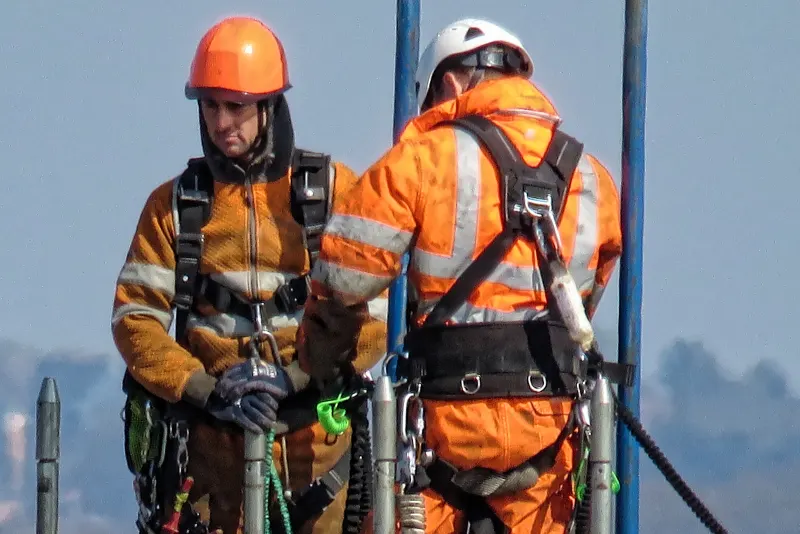
What this section covers: Work at height, Ladders, Scaffolds and mobile towers, Roofs and fragile surfaces, Excavations, Underground services, Overhead power lines, Site vehicles and plant.
10 free practice questions
Click an answer: you see at once whether it is right, with the explanation.
-
Question 1How often must a scaffold used for construction work be inspected?
Show the answer
Answer: B — Before it is first used, then every 7 days, and after anything likely to affect it, such as bad weather or substantial alteration.
HSE says a construction scaffold should be inspected before it is used for the first time, then every 7 days until removed, and each time it is exposed to conditions likely to cause deterioration, such as adverse weather or substantial alteration.
Checked against: HSE: Construction FAQ - Work at height (source)
-
Question 2For construction work, what is the minimum height of the top guardrail above a scaffold working platform?
Show the answer
Answer: D — 950 mm.
HSE says the top guardrail on a construction scaffold should be at least 950 mm above the working platform, and any gap between the top rail and the intermediate rail should not exceed 470 mm.
Checked against: HSE: Construction FAQ - Work at height (source)
-
Question 3On a construction scaffold, what is the largest gap allowed between the top guardrail and the intermediate guardrail?
Show the answer
Answer: D — 470 mm.
HSE states that the gap between the top guardrail and the intermediate rail should not exceed 470 mm. The top rail must be at least 950 mm above the platform, with suitable toe boards.
Checked against: HSE: Construction FAQ - Work at height (source)
-
Question 4Before moving a mobile tower scaffold, which of these must you do?
Show the answer
Answer: B — Reduce its height to no more than 4 m, check for overhead power lines and uneven ground, and push it from the base with nobody on it.
HSE says when moving a tower you should reduce the height to a maximum of 4 m, check there are no power lines or other obstructions overhead, check the ground is firm and level, and push or pull from the base only. Never move it with people or materials on it.
Checked against: HSE: Tower scaffolds (source)
-
Question 5Why must a ladder never be stood on a mobile tower scaffold platform to gain extra height?
Show the answer
Answer: C — It can cause the tower to overturn.
HSE lists using a ladder on a tower, causing it to overturn, as a common cause of incidents. Towers must never be used as a support for ladders, trestles or other access equipment.
Checked against: HSE: Tower scaffolds (source)
-
Question 6What is the preferred way of securing a leaning ladder to stop it slipping?
Show the answer
Answer: A — Tie it to a suitable point, making sure both stiles are tied.
HSE gives the order: tie the ladder with both stiles tied; if not practical, use an effective stability device; if not possible, securely wedge it; footing the ladder is the last resort.
Checked against: HSE: Safe use of ladders and stepladders - Securing ladders (source)
-
Question 7When using a leaning ladder, which rungs should you not work from?
Show the answer
Answer: B — The top three rungs.
HSE says do not work off the top three rungs, and try to make sure the ladder extends at least 1 metre (three rungs) above where you are working.
Checked against: HSE: Safe use of ladders and stepladders - Types of ladder and using them safely (source)
-
Question 8Why should plant and vehicles not be parked close to the sides of an excavation?
Show the answer
Answer: A — The extra load can make the sides of the excavation more likely to collapse.
HSE says not to park plant and vehicles close to the sides of excavations, because the extra loadings can make the sides more likely to collapse.
Checked against: HSE: Excavations (source)
-
Question 9Depending on conditions, how much can one cubic metre of soil weigh?
Show the answer
Answer: D — More than 1.5 tonnes.
HSE reminds workers that, depending on conditions, a cubic metre of soil can weigh in excess of 1.5 tonnes. Even a small collapse can bury and crush someone in a trench.
Checked against: HSE: Excavations (source)
-
Question 10Overhead power lines are found near the work area. How should they be treated?
Show the answer
Answer: C — As live, unless their owners have proved otherwise.
HSE says to assume overhead lines are live unless proved otherwise by their owners. Lines on wooden poles should not be mistaken for telephone wires, and close approach alone can cause a flashover.
Checked against: HSE: Electricity - overhead power lines (source)
More CITB HS&E test (CSCS test) practice
Full free CITB HS&E test (CSCS test) practice test
Mixed questions, test format and official rules.
Working environment: CSCS practice questions
10 free questions
Occupational health: CSCS practice questions
10 free questions
Safety: CSCS practice questions
10 free questions
Specialist activities: CSCS practice questions
10 free questions
The Health, safety and environment (HS&E) test is owned and run by CITB. CSCS is the Construction Skills Certification Scheme. passmock is an independent practice service and is not affiliated with or endorsed by CITB, CSCS or Pearson VUE. Our questions are original and are not taken from the CITB question bank. Original practice questions, not questions from the real test.