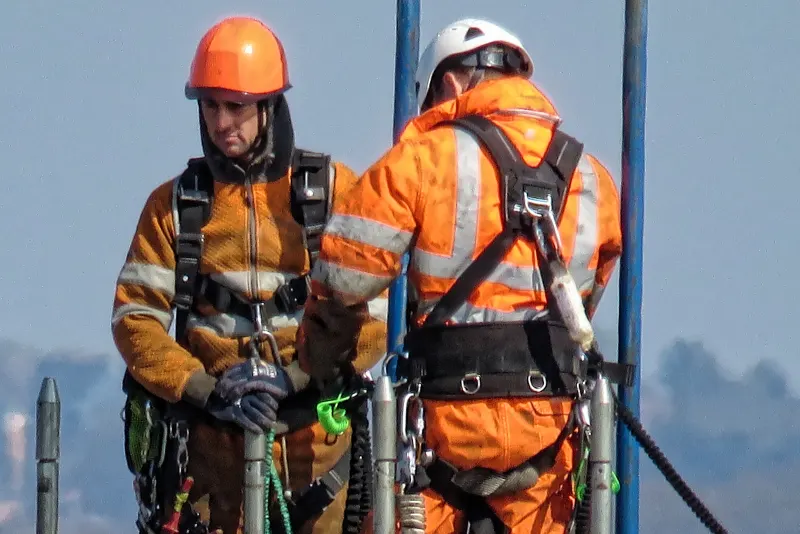
What this section covers: Personal protective equipment, Fire safety, Safety signs, Slips, trips and housekeeping, Electrical safety of tools, Work equipment and guards, First aid, Pedestrians and site traffic.
10 free practice questions
Click an answer: you see at once whether it is right, with the explanation.
-
Question 1What shape and colours does a prohibition sign have?
Show the answer
Answer: B — Round, with a black pictogram on white, a red edge and a red diagonal line.
HSE's L64 guidance says prohibition signs are round, with a black pictogram on a white background and red edging and diagonal line. They tell you what you must not do, such as 'no smoking'.
Checked against: HSE L64 (third edition): Safety signs and signals (source)
-
Question 2A triangular sign with a black pictogram on a yellow background is what type of sign?
Show the answer
Answer: D — A warning sign.
Warning signs are triangular with a black pictogram on a yellow background and a black edge. They mean be careful and take precautions, for example 'danger: electricity'.
Checked against: HSE L64 (third edition): Safety signs and signals (source)
-
Question 3What does a rectangular or square sign with a white pictogram on a green background show?
Show the answer
Answer: A — Emergency escape or first-aid information.
HSE's L64 guidance says emergency escape and first-aid signs are rectangular or square with a white pictogram on a green background, pointing to doors, exits, escape routes and first-aid equipment.
Checked against: HSE L64 (third edition): Safety signs and signals (source)
-
Question 4Which three things are needed for a fire to start?
Show the answer
Answer: C — A source of ignition, a source of fuel and oxygen.
HSE's construction fire FAQ explains that for a fire to start, three things are needed: a source of ignition, a source of fuel and oxygen. Removing any one of them prevents or stops the fire.
Checked against: HSE: Construction FAQ - Fire (source)
-
Question 5According to HSE's construction fire guidance, which extinguisher is matched to fires in wood, paper and cloth?
Show the answer
Answer: C — Water.
HSE lists water extinguishers for wood, paper and cloth, dry powder or foam for flammable liquids and CO2 for electrical fires. Extinguishers should be at identified fire points and nominated people trained to use them.
Checked against: HSE: General fire safety (construction) (source)
-
Question 6According to HSE's construction fire guidance, which extinguishers are matched to fires involving flammable liquids?
Show the answer
Answer: A — Dry powder or foam.
HSE's guidance lists dry powder or foam extinguishers for flammable liquids. Water can spread a burning liquid fire.
Checked against: HSE: General fire safety (construction) (source)
-
Question 7Where should high-visibility clothing be worn on a construction site?
Show the answer
Answer: D — In all areas where vehicles or plant are operating, including by drivers when they leave their vehicle.
HSE says high-visibility clothing should be worn in all construction locations where vehicles or plant are operating, including by drivers when they leave their vehicle. If the site has a hi-vis policy you must follow it.
Checked against: HSE: Construction FAQ - Personal protective equipment (source)
-
Question 8What do steel toecaps (or equivalent) in safety footwear protect against?
Show the answer
Answer: B — Objects being dropped on the feet.
HSE says steel toecaps or equivalent protect against dropped objects, and midsole protection guards against sharp objects coming up through the sole. Construction workers are expected to wear protective footwear on site.
Checked against: HSE: Construction FAQ - Personal protective equipment (source)
-
Question 9What does an appointed person do for first aid on a small site?
Show the answer
Answer: A — Looks after the first-aid equipment and facilities and calls the emergency services when required.
HSE's construction first-aid FAQ says the appointed person looks after first-aid equipment and facilities and calls the emergency services when required. Appointed persons do not need first-aid training.
Checked against: HSE: Construction FAQ - First aid (source)
-
Question 10What does HSE advise for cables used for temporary lighting or mains-powered tools, especially along corridors?
Show the answer
Answer: C — Run them at high level, or use cordless tools where possible.
HSE's slips and trips guidance says that if you can use cordless tools you may not need cables at all, and that cables for temporary lighting or mains tools should be run at high level, especially along corridors.
Checked against: HSE: Slips and trips (construction) (source)
More CITB HS&E test (CSCS test) practice
Full free CITB HS&E test (CSCS test) practice test
Mixed questions, test format and official rules.
Working environment: CSCS practice questions
10 free questions
Occupational health: CSCS practice questions
10 free questions
High risk activities: CSCS practice questions
10 free questions
Specialist activities: CSCS practice questions
10 free questions
The Health, safety and environment (HS&E) test is owned and run by CITB. CSCS is the Construction Skills Certification Scheme. passmock is an independent practice service and is not affiliated with or endorsed by CITB, CSCS or Pearson VUE. Our questions are original and are not taken from the CITB question bank. Original practice questions, not questions from the real test.