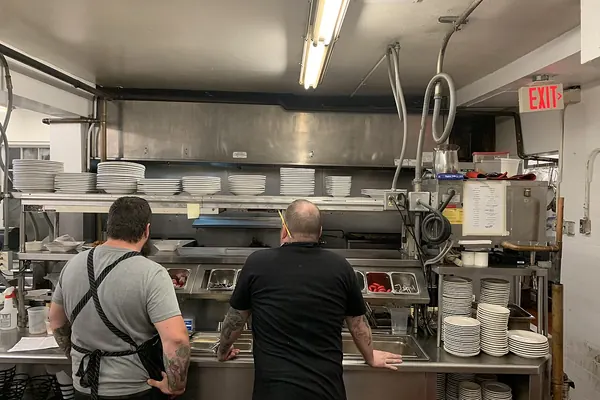
What this section covers: Cleaning versus sanitizing versus disinfecting, Manual and machine warewashing, Sanitizer concentration, temperature, contact time, Cleaning frequency and vomit or diarrhea cleanup.
6 free practice questions
Click an answer: you see at once whether it is right, with the explanation.
-
Question 1What minimum water temperature does the Food Code give for a quaternary ammonium (quat) sanitizer solution?
Show the answer
Answer: C — 75°F.
A quat sanitizer must be at least 75°F, at the concentration on the label, in water with a hardness of 500 mg/L or less (or as the label states).
Checked against: FDA Food Code 2022, 4-501.114 (C) Quaternary ammonium compound
-
Question 2In a hot-water dish machine, what utensil surface temperature shows that sanitizing worked?
Show the answer
Answer: D — 160°F, measured with an irreversible registering temperature indicator.
Hot water mechanical sanitizing must reach a utensil surface temperature of 160°F (71°C), checked with an irreversible registering temperature indicator such as a heat-sensitive label or maximum-registering thermometer.
Checked against: FDA Food Code 2022, 4-703.11 Hot Water and Chemical (B)
-
Question 3What does the Food Code require for vomiting or diarrheal events in a food establishment?
Show the answer
Answer: A — Written procedures employees follow to clean up and limit the spread of contamination.
A food establishment must have written procedures for responding to vomiting and diarrheal events, addressing the actions employees take to limit the spread of contamination and exposure of people, food and surfaces.
Checked against: FDA Food Code 2022, 2-501.11 Clean-up of Vomiting and Diarrheal Events
-
Question 4What are the steps of manual warewashing in a 3-compartment sink?
Show the answer
Answer: C — Scrape, wash, rinse, sanitize, air-dry.
Items are scraped, washed in detergent, rinsed, sanitized with hot water or chemicals, then air-dried. Sanitizing a soiled or soapy item does not work well.
Checked against: FDA Food Code 2022, 4-603.16 Rinsing Procedures; 4-703.11; 4-901.11 Air-Drying Required
-
Question 5What is the difference between sanitizing and disinfecting in the Supplement to the 2022 Food Code?
Show the answer
Answer: B — Disinfection destroys or irreversibly inactivates bacteria, fungi and viruses (not necessarily spores) and is required when available sanitizers do not control the pathogen of concern, for example after contamination with vomit; sanitizing treats cleaned food-contact surfaces.
The Supplement added a definition of disinfection, separate from sanitization, and a new Part 4-10: surfaces are disinfected when sanitizers do not control the pathogen of concern, such as after contamination with vomit or other bodily fluids. Disinfectants are poisonous or toxic materials and are handled as such.
Checked against: FDA Food Code 2022, Supplement to the 2022 Food Code, 1-201.10 Disinfection; 4-1001.11; 4-1002.11
-
Question 6How should the concentration of a chemical sanitizer be checked?
Show the answer
Answer: D — With a test kit, used according to the manufacturer's label instructions.
The concentration of a sanitizing solution must be accurately determined with a test kit or other device, and the Supplement adds that the kit must be used according to the manufacturer's label.
Checked against: FDA Food Code 2022, 4-501.116 Warewashing Equipment, Determining Chemical Sanitizer Concentration
Secure payment by Stripe · Card, Apple Pay · One-off, instant access
Instant access to your online tests and PDF after payment · Terms of sale
Sanitizing rules in numbers
| Method | Food Code 2022 rule |
|---|---|
| Hot water, manual | 171°F or above, immersed at least 30 seconds (4-501.111, 4-703.11) |
| Hot water, machine | Final rinse 180°F (165°F for stationary-rack single-temperature machines), no more than 194°F; utensil surface 160°F (4-501.112, 4-703.11) |
| Chlorine | 25-49 mg/L at 120°F; 50-99 mg/L at 75°F (pH 8 or less) or 100°F (pH 10 or less); 100 mg/L at 55°F; contact time at least 10 seconds, or 7 seconds for 50 mg/L at the listed pH and temperature (4-501.114, 4-703.11) |
| Iodine | 12.5 to 25 mg/L, at least 68°F, pH 5.0 or less (4-501.114) |
| Quaternary ammonium | Label concentration, at least 75°F, water hardness 500 mg/L or less (4-501.114) |
| Other chemicals | Contact time at least 30 seconds unless the label says otherwise (4-703.11) |
Food-contact surfaces used with TCS food are cleaned at least every 4 hours, with exceptions such as refrigerated rooms (4-602.11). Every establishment needs written procedures for vomiting and diarrheal events (2-501.11), and the Supplement adds rules on disinfection, separate from sanitizing. Source: FDA Food Code 2022.
More Food Protection Manager Exam (CFPM) practice
Full free Food Protection Manager Exam (CFPM) practice test
Mixed questions, test format and official rules.
Foodborne illness and allergens: food manager questions
6 free questions
Receiving and storage: food manager practice questions
6 free questions
Cooking, cooling and holding: food manager questions
6 free questions
HACCP and active managerial control practice questions
6 free questions
Facilities and pest control: food manager questions
6 free questions
ServSafe is a registered trademark of the National Restaurant Association. passmock is not affiliated with or endorsed by the National Restaurant Association, the National Registry of Food Safety Professionals (NRFSP), Pearson VUE, Prometric, 360training, ANAB, the Conference for Food Protection, the FDA or any state or local health department. Original practice questions, not questions from the real test.
Short on time? A professional can help
Prefer to work with a professional? A tutor, a prep course or a driving school: we can pass your request to up to 3 partners. Free, no obligation; passmock does not teach. How to choose.