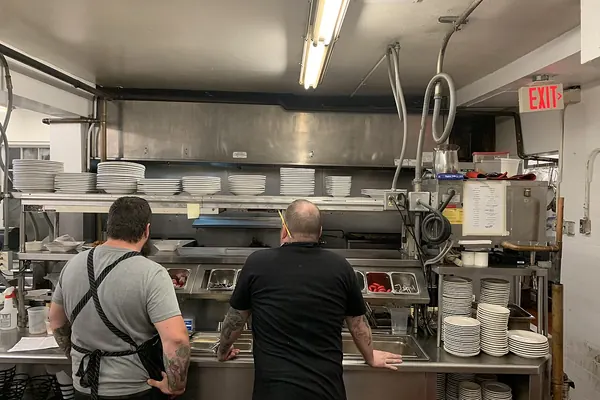
What this section covers: Active managerial control and the person in charge, The 7 HACCP principles, When a HACCP plan or a variance is required, Reduced oxygen packaging, Inspections and imminent health hazards.
6 free practice questions
Click an answer: you see at once whether it is right, with the explanation.
-
Question 1What does "active managerial control" mean?
Show the answer
Answer: C — Managers building food safety into daily operations to control the risk factors of foodborne illness, rather than reacting after problems.
Active managerial control is a proactive approach: the person in charge uses procedures, training, monitoring and corrective actions to control foodborne illness risk factors every day. The Supplement to the 2022 Food Code defines it and makes it a duty of the person in charge.
Checked against: FDA Food Code 2022, Supplement to the 2022 Food Code, 1-201.10 Active managerial control; 2-103.11
-
Question 2What is a critical control point (CCP)?
Show the answer
Answer: C — A point or procedure in a food process where loss of control may result in an unacceptable health risk.
A CCP is a step where control can be applied and is essential to prevent, eliminate or reduce a hazard. Cooking and cooling are common CCPs.
Checked against: FDA Food Code 2022, 1-201.10 Definitions, Critical control point
-
Question 3In a HACCP plan for roast chicken, "165°F in all parts" is an example of what?
Show the answer
Answer: A — A critical limit.
A critical limit is the maximum or minimum value a physical, biological or chemical parameter must meet at a CCP to control the hazard, such as a cooking temperature.
Checked against: FDA Food Code 2022, 1-201.10 Definitions, Critical limit
-
Question 4During monitoring, a cook finds a batch of chicken reached only 150°F. In HACCP terms, continuing to cook it until it reaches 165°F is what?
Show the answer
Answer: C — A corrective action.
Corrective actions are the steps taken when monitoring shows a critical limit was not met: here, continuing to cook until the limit is reached, and recording what was done.
Checked against: FDA Food Code 2022, 8-201.14 (E)(5); Annex 4 (corrective actions)
-
Question 5Which activity requires a variance from the regulatory authority?
Show the answer
Answer: B — Curing food.
A variance is required before smoking food for preservation, curing, using additives such as vinegar to preserve food or to make it non-TCS, some reduced oxygen packaging, live shellfish display tanks, custom processing animals, sprouting seeds or beans, or other methods the regulatory authority decides need one.
Checked against: FDA Food Code 2022, 3-502.11 Variance Requirement
-
Question 6According to the Food Code, which is one way a person in charge can demonstrate food safety knowledge during an inspection?
Show the answer
Answer: D — Being a certified food protection manager from an accredited program.
The person in charge demonstrates knowledge by having no priority violations during the inspection, by being a certified food protection manager from an accredited program, or by answering the inspector's questions correctly.
Checked against: FDA Food Code 2022, 2-102.11 Demonstration
Secure payment by Stripe · Card, Apple Pay · One-off, instant access
Instant access to your online tests and PDF after payment · Terms of sale
HACCP in seven principles
- Conduct a hazard analysis.
- Determine the critical control points (CCPs).
- Establish critical limits.
- Establish monitoring procedures.
- Establish corrective actions.
- Establish verification procedures.
- Establish record keeping and documentation.
A critical control point is a point or procedure where loss of control may result in an unacceptable health risk; a critical limit is the value that must be met there, such as 165°F for chicken (Food Code 2022, 1-201.10).
When a HACCP plan or a variance is required
A variance is needed before smoking food for preservation, curing, using additives such as vinegar to preserve food or make it non-TCS, some reduced oxygen packaging, operating a live shellfish display tank, custom processing animals or sprouting seeds or beans (3-502.11). A HACCP plan is submitted when law requires it, when such a variance is required, and before reduced oxygen packaging without a variance (8-201.13).
Active managerial control
The Supplement to the 2022 Food Code defines active managerial control and makes maintaining it a duty of the person in charge (2-103.11): specific actions and procedures that management builds into the operation to control foodborne illness risk factors, a preventive rather than reactive approach backed by continuous monitoring and verification.
More Food Protection Manager Exam (CFPM) practice
Full free Food Protection Manager Exam (CFPM) practice test
Mixed questions, test format and official rules.
Foodborne illness and allergens: food manager questions
6 free questions
Receiving and storage: food manager practice questions
6 free questions
Cooking, cooling and holding: food manager questions
6 free questions
Cleaning and sanitizing: food manager practice questions
6 free questions
Facilities and pest control: food manager questions
6 free questions
ServSafe is a registered trademark of the National Restaurant Association. passmock is not affiliated with or endorsed by the National Restaurant Association, the National Registry of Food Safety Professionals (NRFSP), Pearson VUE, Prometric, 360training, ANAB, the Conference for Food Protection, the FDA or any state or local health department. Original practice questions, not questions from the real test.
Short on time? A professional can help
Prefer to work with a professional? A tutor, a prep course or a driving school: we can pass your request to up to 3 partners. Free, no obligation; passmock does not teach. How to choose.