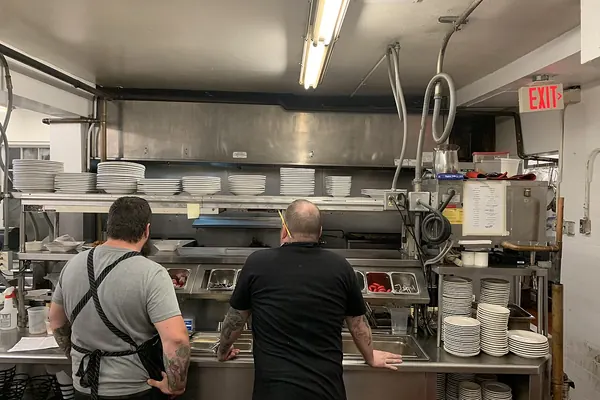
What this section covers: Water, plumbing, backflow and handwashing sinks, Equipment and thermometers, Garbage, toilet rooms, lighting and ventilation, Pest prevention and pesticides.
6 free practice questions
Click an answer: you see at once whether it is right, with the explanation.
-
Question 1What minimum water temperature must a handwashing sink provide?
Show the answer
Answer: B — 85°F.
A handwashing sink must provide water at a temperature of at least 85°F (29.4°C) through a mixing valve or combination faucet. A metering faucet must run at least 15 seconds without being reactivated.
Checked against: FDA Food Code 2022, 5-202.12 Handwashing Sink, Installation
-
Question 2What minimum light intensity does the Food Code require at a surface where employees prepare food or use knives and slicers?
Show the answer
Answer: C — 50 foot candles (540 lux).
Work surfaces where food employees prepare food or use utensils such as knives, slicers, grinders or saws need at least 50 foot candles. Walk-in coolers and dry storage need at least 10, and handwashing and warewashing areas at least 20.
Checked against: FDA Food Code 2022, 6-303.11 Intensity
-
Question 3Where should the temperature sensor be placed in a refrigerator used for TCS food?
Show the answer
Answer: B — In the warmest part of the unit.
In a refrigerated unit the sensor measures the warmest part, and in a hot holding unit the coolest part, so the reading shows the worst case for food safety.
Checked against: FDA Food Code 2022, 4-204.112 Temperature Measuring Devices
-
Question 4What kind of door must a toilet room inside a food establishment have?
Show the answer
Answer: C — A tight-fitting, self-closing door.
A toilet room on the premises must be completely enclosed with a tight-fitting and self-closing door, to keep insects and odors away from food areas.
Checked against: FDA Food Code 2022, 6-202.14 Toilet Rooms, Enclosed
-
Question 5Which animal is generally allowed in the dining area of a food establishment?
Show the answer
Answer: B — A service animal accompanying a person with a disability.
Live animals are not allowed on the premises, with exceptions such as service animals controlled by a person with a disability in dining and sales areas, edible fish or shellfish on display, patrol dogs, and pet dogs in outdoor dining areas if the regulatory authority approves.
Checked against: FDA Food Code 2022, 6-501.115 Prohibiting Animals
-
Question 6Why does the Food Code require outdoor refuse containers to be kept covered with tight-fitting lids or doors?
Show the answer
Answer: B — To keep pests from reaching the refuse and to limit odors and contamination.
Receptacles for refuse and recyclables kept outside must be covered with tight-fitting lids or doors, so they do not attract or feed insects and rodents.
Checked against: FDA Food Code 2022, 5-501.113 Covering Receptacles (B)
Secure payment by Stripe · Card, Apple Pay · One-off, instant access
Instant access to your online tests and PDF after payment · Terms of sale
Facilities and pests
| Item | Food Code 2022 rule |
|---|---|
| Air gap | At least twice the diameter of the water inlet and never less than 1 inch (5-202.13) |
| Handwashing sink | Water at least 85°F; metering faucet at least 15 seconds; handwashing only (5-202.12, 5-205.11) |
| Light | 50 foot candles where food is prepared or knives and slicers are used; 20 in handwashing, warewashing areas and inside reach-ins; 10 in walk-ins and dry storage (6-303.11) |
| Toilet rooms | Completely enclosed with a tight-fitting, self-closing door (6-202.14) |
| Thermometers | Food thermometers accurate to plus or minus 2°F (or 1°C); a sensor in the warmest part of each cooler (4-203.11, 4-204.112) |
| Refuse | Outdoor containers covered and on a smooth, nonabsorbent surface (5-501.11, 5-501.113) |
| Pests | Routine inspection, closed outer openings, no harborage; rodent bait only in covered, tamper-resistant stations (6-501.111, 7-206.12) |
| Animals | Not allowed on the premises, except listed cases such as service animals (6-501.115) |
Source: FDA Food Code 2022.
More Food Protection Manager Exam (CFPM) practice
Full free Food Protection Manager Exam (CFPM) practice test
Mixed questions, test format and official rules.
Foodborne illness and allergens: food manager questions
6 free questions
Receiving and storage: food manager practice questions
6 free questions
Cooking, cooling and holding: food manager questions
6 free questions
HACCP and active managerial control practice questions
6 free questions
Cleaning and sanitizing: food manager practice questions
6 free questions
ServSafe is a registered trademark of the National Restaurant Association. passmock is not affiliated with or endorsed by the National Restaurant Association, the National Registry of Food Safety Professionals (NRFSP), Pearson VUE, Prometric, 360training, ANAB, the Conference for Food Protection, the FDA or any state or local health department. Original practice questions, not questions from the real test.
Short on time? A professional can help
Prefer to work with a professional? A tutor, a prep course or a driving school: we can pass your request to up to 3 partners. Free, no obligation; passmock does not teach. How to choose.