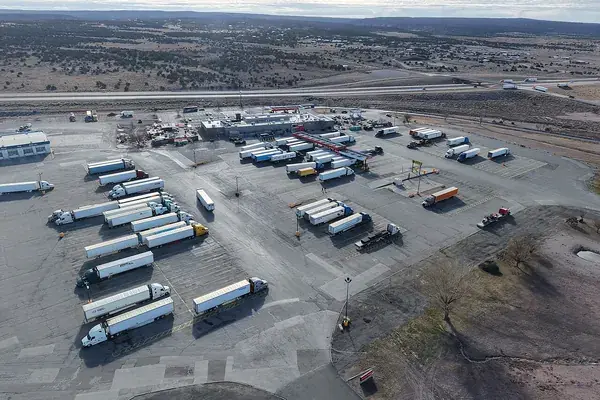
Who has to complete ELDT
FMCSA's rules apply to anyone seeking to (FMCSA, ELDT):
- obtain a Class A or Class B CDL for the first time;
- upgrade an existing Class B CDL to Class A; or
- obtain a school bus (S), passenger (P) or hazardous materials (H) endorsement for the first time.
Class C on its own, and the doubles/triples (T) and tank (N) endorsements, are not on the list (49 CFR 380.609). A Class C passenger driver still needs ELDT for the first P endorsement.
Who is not covered
- Earlier licenses. The rules are not retroactive: a CDL or S, P or H endorsement issued before February 7, 2022 needs no training (FMCSA).
- Earlier permits. If you got your CLP before February 7, 2022 and obtain the CDL before that CLP (or its renewal) expires, you are not subject to ELDT. A CLP issued on or after that date means you are (49 CFR 380.603).
- Skills test exceptions. Drivers excepted from CDL requirements, some restricted CDLs, military drivers who qualify for the skills test waiver, and drivers who only want to remove a restriction under 49 CFR 383.135(b)(7) (the air brake, full air brake or manual transmission restriction) are exempt. What removing the air brake restriction involves is in our CDL air brakes test guide.
When it has to be done
The deadline is a test, not the permit (49 CFR 383.71(a)(10)):
| You want | ELDT must be completed before |
|---|---|
| First Class A or B CDL, or B to A upgrade | The CDL skills test |
| First P or S endorsement | The P or S skills test |
| First H endorsement | The hazmat knowledge test |
FMCSA states there is no federal requirement to finish ELDT theory before applying for a CLP. In practice the order is: pass the general knowledge test and get your CLP, train, then take the skills test after at least 14 days with the permit. One constraint pushes the permit first: a training provider must check that every behind-the-wheel trainee holds a valid CLP or CDL. Some states add their own rules on top.
What the training includes
ELDT has two parts, theory and behind-the-wheel (BTW). The curricula are in appendices A to E of Part 380: Class A, Class B, passenger, school bus and hazmat.
Theory
- No minimum number of hours. The instructor must cover every topic in the curriculum.
- It can be classroom, computer-based or online. Online-only providers do not have to meet state rules for theory instructors (49 CFR 380.605).
- It ends with a written assessment, and you need an overall score of at least 80 percent (49 CFR 380.715).
- The Class A theory curriculum covers, among other units, basic operation, safe operating procedures, advanced practices, vehicle systems and reporting malfunctions, and non-driving activities such as hours of service, drug and alcohol rules and medical requirements.
- A driver who already holds a valid Class B CDL may take the shorter Class A theory upgrade curriculum.
Behind-the-wheel
- Two settings: a range (an area free of obstructions) and public roads. Time spent watching someone else drive does not count (49 CFR 380.605).
- No minimum number of hours federally, but the instructor must document that you showed proficiency in every element, and record your total clock hours.
- A simulator cannot be used for BTW training or to show proficiency.
- Class A BTW must be in a vehicle that needs a Class A CDL. The range units include pre-trip, en route and post-trip inspection, straight-line backing, 45/90-degree alley dock, offset backing, parallel parking on the blind and sight sides, and coupling and uncoupling.
- The hazmat curriculum is theory only.
Who can teach
Instructors must hold a CDL of the same or higher class with the needed endorsements and have at least 2 years of experience driving that kind of vehicle or as a BTW instructor (49 CFR 380.605). You can take theory from one provider and BTW from another, but the range and public-road parts of BTW must come from the same provider (49 CFR 380.707).
Time limit
Except for the H endorsement, you must complete theory and BTW within one year of completing the first portion (49 CFR 380.603).
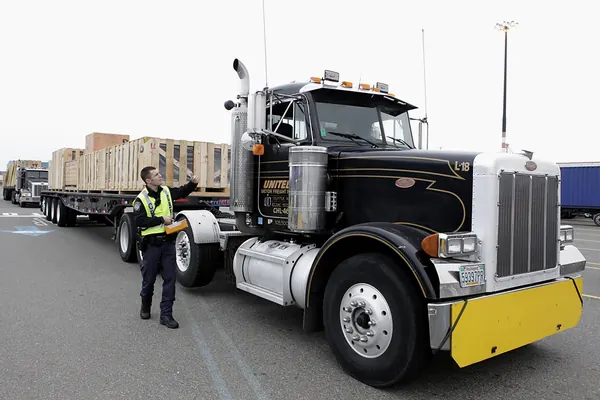
The Training Provider Registry
Training counts only if the provider is listed on FMCSA's Training Provider Registry. On October 3, 2026 the registry showed 18,258 active providers at 31,059 locations, and 2,032,201 drivers trained since February 2022.
What you do, per the registry: confirm that ELDT applies to you, choose a provider from the registry, and complete the course. The provider then reports your completion, and must do so by midnight of the second business day after you finish (49 CFR 380.717). The report includes your license or permit number, the class or endorsement, the type of training, your BTW clock hours and the completion date. You can look it up with the registry's Check My Record tool, and your state must verify it electronically before giving you the skills test or the hazmat knowledge test (California DMV).
Before paying a school, search for it on the registry yourself, and check which location is listed: a provider with several campuses must register each training location to get a registry number for it.
State additions
Federal ELDT is a minimum. California, for example, also requires at least 15 hours of behind-the-wheel training for an original Class A or B CDL, certified on its form DL 1236 before the license is issued, and accepts ELDT completed in another state (California DMV). Check your own state's CDL page.
Related guides
Which class to train for is covered in Class A vs Class B, the P, S and H endorsements in CDL endorsements, and the first part of the skills test in the CDL pre-trip inspection. For the written tests, use our CDL practice tests and the CDL practice pack; they help you prepare for the state knowledge tests, not the ELDT theory assessment, which each provider writes.
More CDL Knowledge Tests guides
CDL pre-trip inspection: how the vehicle inspection test works
How the CDL pre-trip (vehicle inspection) test works, what to check and say at each part of the truck, the numbers to know and the daily inspection rules.
Published November 5, 2026
CDL Class A vs Class B: what each license lets you drive
The federal definitions of Class A and Class B CDLs (26,001 lb and the 10,000 lb trailer rule), what each lets you drive, the tests each needs and the ELDT rule.
Published October 29, 2026
CDL endorsements and restrictions explained
What each CDL endorsement allows, which tests it needs, the TSA check and training for hazmat, and what restriction codes such as L, Z, E and O mean on a license.
Published October 25, 2026
CDL general knowledge test: questions, topics and passing score
How many questions are on the CDL general knowledge test, the 80% rule, what the test covers by manual section and which other permit tests your license class needs.
Published October 21, 2026
CDL air brakes test: the written test and the air brake check
The CDL air brakes knowledge test, the L restriction if you skip or fail it, and the in-cab air brake check with the limits in the California and New York manuals.
New on passmock
The Next Generation NCLEX, explained
What the Next Generation NCLEX changed in 2023: the six-step clinical judgment model, case studies and stand-alone items, partial-credit scoring, and how to prepare.
Published November 10, 2026
CSCS test revision: what is tested and how to revise
What the CITB HS&E (CSCS) test covers, how its questions work since 2019, the official GT100 book and app, and a realistic plan for the 90% pass mark.
Published November 8, 2026
How many questions are on the CNA exam, and how long is it?
CNA exam length by state: 70 questions in 2 hours on the NNAAP, 60 in 90 minutes with Prometric, 75 in Tennessee, 79 in Ohio, plus the skills test time.
Published November 7, 2026
Sources
- Entry-Level Driver Training (ELDT) — FMCSA (checked October 3, 2026)
- How do I get a Commercial Driver's License? — FMCSA (checked October 3, 2026)
- Training Provider Registry — FMCSA (checked October 3, 2026)
- 49 CFR 380.603, Applicability — eCFR (checked October 3, 2026)
- 49 CFR 380.605, Definitions — eCFR (checked October 3, 2026)
- 49 CFR 380.609, General entry-level driver training requirements — eCFR (checked October 3, 2026)
- 49 CFR 380.703, Requirements for listing on the TPR — eCFR (checked October 3, 2026)
- 49 CFR 380.707, Entry-level training provider — eCFR (checked October 3, 2026)
- 49 CFR 380.715, Assessments — eCFR (checked October 3, 2026)
- 49 CFR 380.717, Training certification — eCFR (checked October 3, 2026)
- 49 CFR Part 380, appendices A to E (ELDT curricula) — eCFR (checked October 3, 2026)
- 49 CFR 383.71, Driver application and certification procedures — eCFR (checked October 3, 2026)
- Commercial Driver's Licenses (CDL), ELDT section — California DMV (checked October 3, 2026)
passmock is an independent practice service. It is not affiliated with or endorsed by the Federal Motor Carrier Safety Administration (FMCSA), the U.S. Department of Transportation, the American Association of Motor Vehicle Administrators (AAMVA) or any state DMV, DPS or driver licensing agency. Our questions are original practice questions written from the official state CDL manuals and federal regulations; they are not taken from any state's test.
Short on time? A professional can help
Prefer to work with a professional? A tutor, a prep course or a driving school: we can pass your request to up to 3 partners. Free, no obligation; passmock does not teach. How to choose.