Free Illinois permit test practice test (20 questions)
Click an answer to see instantly if it is right, with the explanation. No sign-up, no email.
-
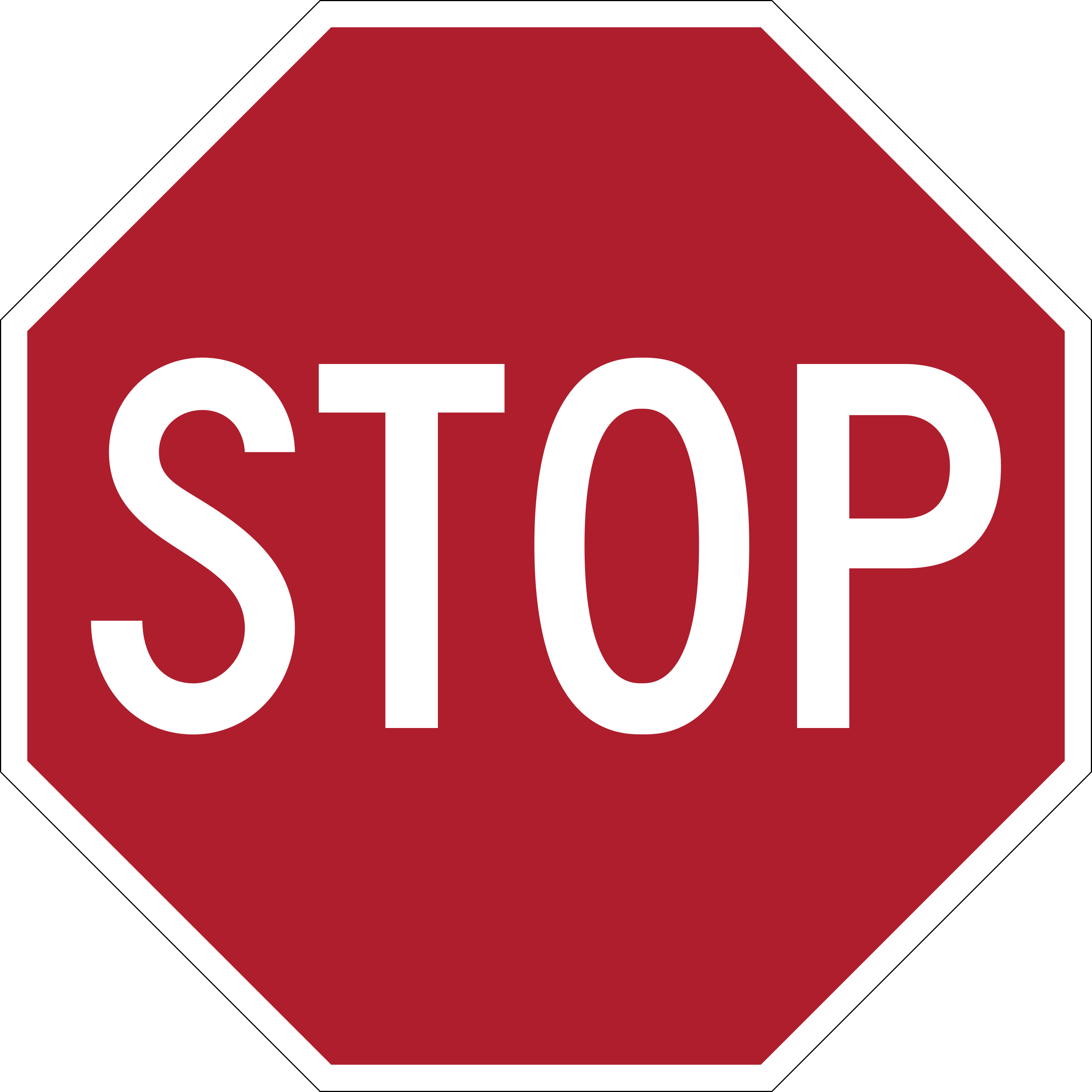
Question 1You reach an eight-sided red sign. There is no stop line and no crosswalk. Where must you stop?
Show the answer
Answer: D — Before entering the intersection.
The STOP sign requires a complete stop at the stop line; if there is none, before the crosswalk; if there is no crosswalk, before entering the intersection. You then yield to pedestrians and approaching traffic.
Checked against: Illinois Rules of the Road 2026, Ch. 9 Roadway Signs — Shapes of Signs (p. 63-64)
-
Question 2What does a round yellow sign with a black X and the letters RR tell you?

Show the answer
Answer: B — A railroad crossing is ahead.
The round sign is an advance warning that a railroad track crosses the road ahead. In rural areas it may be placed up to 750 feet before the crossing, so slow down, look and listen.
Checked against: Illinois Rules of the Road 2026, Ch. 9 Roadway Signs — Shapes of Signs (p. 63-64)
-
Question 3A five-sided (pentagon) yellow or yellow-green sign warns you about:

Show the answer
Answer: A — A school zone or school crossing.
The five-sided sign means SCHOOL ZONE or SCHOOL CROSSING. With two children walking and a downward arrow, you are at the crossing itself.
Checked against: Illinois Rules of the Road 2026, Ch. 9 Roadway Signs — Shapes of Signs (p. 63-64)
-
Question 4Orange warning signs are usually found:
Show the answer
Answer: C — In construction or maintenance zones.
Orange is used for warning signs in construction or maintenance zones. They alert you to possible dangers caused by the work ahead.
Checked against: Illinois Rules of the Road 2026, Ch. 9 Roadway Signs — Colors of Signs (p. 64-65)
-
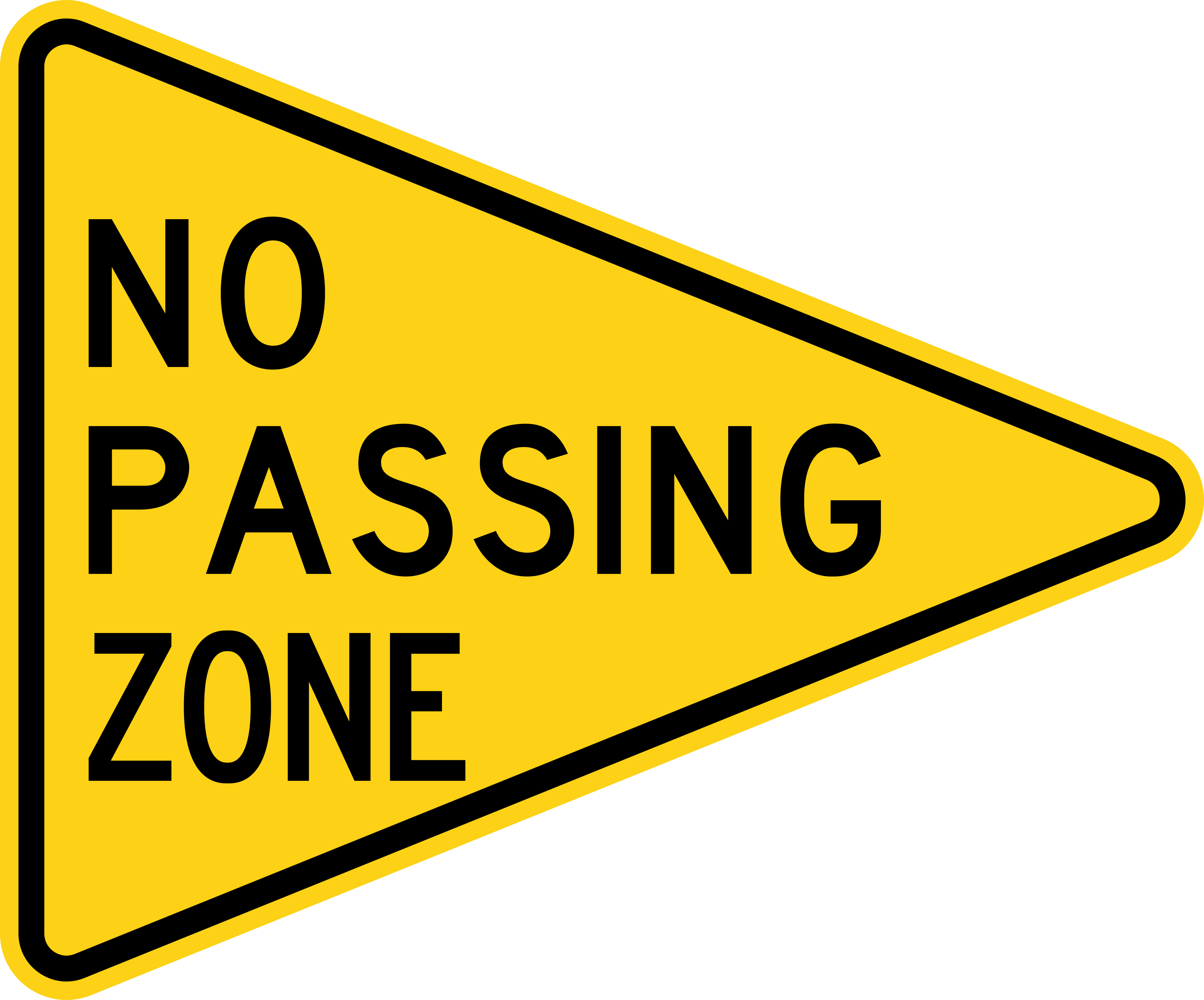
Question 5A yellow, three-sided sign shaped like a pennant is posted on the left side of a two-lane, two-way road. What does it mean?
Show the answer
Answer: D — A no passing zone begins here.
The pennant-shaped yellow sign marks a NO PASSING ZONE. It is placed on the left side of the road at the start of the area where no-passing pavement markings are also used.
Checked against: Illinois Rules of the Road 2026, Ch. 9 Roadway Signs — Shapes of Signs (p. 63-64)
-
Question 6What is a brown sign used for?
Show the answer
Answer: C — Parks and recreation areas.
Brown signs point to parks and recreation. Blue signs are for services, orange for construction and maintenance, and pink may be used for traffic incidents.
Checked against: Illinois Rules of the Road 2026, Ch. 9 Roadway Signs — Colors of Signs (p. 64-65)
-
Question 7A pink sign on the highway most likely warns you about:
Show the answer
Answer: B — An unplanned traffic incident, such as a crash or natural disaster.
Pink may be used for traffic incident signing. These signs alert you to possible dangers caused by unplanned incidents such as traffic crashes and natural disasters.
Checked against: Illinois Rules of the Road 2026, Ch. 9 Roadway Signs — Colors of Signs (p. 64-65)
-
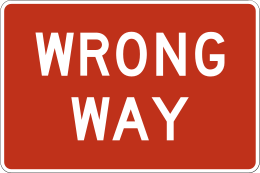
Question 8You pass a DO NOT ENTER sign on an expressway ramp and then see a red and white WRONG WAY sign. What does it tell you?
Show the answer
Answer: A — Your vehicle is traveling in the wrong direction.
The WRONG WAY sign is placed on expressway ramps a short distance past the DO NOT ENTER sign. It means you are going against traffic; stop and turn around safely.
Checked against: Illinois Rules of the Road 2026, Ch. 9 Roadway Signs — Regulatory Signs (p. 65-68)
-
Question 9Outside business and residential areas, how far before turning must you give a continuous turn signal?
Show the answer
Answer: C — At least 200 feet.
In business or residential areas the signal must be given for at least 100 feet. In other areas, such as open highways, it must be given at least 200 feet before turning.
Checked against: Illinois Rules of the Road 2026, Ch. 4 Traffic Laws — Signaling (p. 30)
-
Question 10Two cars on different roads arrive at a four-way stop at the same time. Which one goes first?
Show the answer
Answer: A — The car on the right; the car on the left yields.
At a four-way stop the first driver to stop goes first. When two vehicles on different roadways arrive at the same time, the vehicle on the left yields to the vehicle on the right.
Checked against: Illinois Rules of the Road 2026, Ch. 4 Traffic Laws — Right of Way (p. 26)
-
Question 11True or false: You do not have to stop for a school bus that is stopped on the other side of a four-lane roadway, traveling in the opposite direction.
Show the answer
Answer: A — True.
This is the one exception in the manual: when both vehicles are on a four-lane roadway and the bus is stopped in the opposite direction, you are not required to stop. At any other time you must stop for a school bus loading or unloading.
Checked against: Illinois Rules of the Road 2026, Ch. 4 Traffic Laws — Special Stops, School Buses (p. 32-33)
-
Question 12In Illinois you may not stand or park your vehicle within how many feet of a fire hydrant?
Show the answer
Answer: B — 15 feet.
Standing or parking is prohibited within 15 feet of a fire hydrant. Other statewide limits include 20 feet of a fire station driveway and 30 feet of a STOP sign, YIELD sign or traffic signal.
Checked against: Illinois Rules of the Road 2026, Ch. 4 Traffic Laws — Prohibited Stopping, Standing, or Parking (p. 35-36)
-
Question 13You park facing uphill next to a curb. Which way should you turn your front wheels?
Show the answer
Answer: D — Away from the curb.
Facing uphill with a curb, turn the front wheels away from the curb. Facing downhill with a curb, turn them toward the curb; with no curb, turn them toward the side of the road.
Checked against: Illinois Rules of the Road 2026, Ch. 4 Traffic Laws — Parking, Hill Parking (p. 34)
-
Question 14If you are under 18, how long must you hold your instruction permit before you can get a driver's license?
Show the answer
Answer: C — At least nine consecutive months.
Drivers age 15 to 17 must hold the instruction permit for at least nine consecutive months, with no driving convictions, before getting a license.
Checked against: Illinois Rules of the Road 2026, Ch. 3 Drivers Under Age 21 — Obtaining an Instruction Permit (p. 16)
-
Question 15At what blood-alcohol concentration (BAC) is it illegal to drive in Illinois for drivers 21 and older?
Show the answer
Answer: B — .08% or more.
It is illegal to drive with a BAC of .08% or more. You can still be convicted of DUI below .08% if your driving ability is impaired, and drivers under 21 may not have any trace of alcohol.
Checked against: Illinois Rules of the Road 2026, Ch. 6 DUI — Blood-Alcohol Concentration (p. 48)
-
Question 16How do you use the three-second rule?
Show the answer
Answer: D — Pick a fixed object; when the car ahead passes it, you should not reach it before you count three seconds.
Pick a sign, tree or overpass. When the vehicle ahead passes it, count one-thousand-one to one-thousand-three; if you reach the object first, you are following too closely. Increase the gap in bad road or weather conditions.
Checked against: Illinois Rules of the Road 2026, Ch. 11 Safe Driving Tips — Following Distances (p. 83)
-
Question 17A 17-year-old driver wants to take a call using a hands-free device. Is this allowed?
Show the answer
Answer: A — No; drivers under 19 may not use a phone at all while driving, except to report an emergency.
Any cellphone use while driving, including a hands-free device, is prohibited for drivers under 19. The only exception is an emergency call to law enforcement, a health care provider or emergency services.
Checked against: Illinois Rules of the Road 2026, Ch. 3 — Graduated Driver Licensing Program (p. 18)
-
Question 18Under the Child Passenger Protection Act, which children must be secured in an appropriate child restraint system?
Show the answer
Answer: C — All children under age 8.
The Act requires all children under age 8 to be properly secured in an appropriate child safety restraint system, which includes booster seats. From age 8, the safety belt law applies.
Checked against: Illinois Rules of the Road 2026, Ch. 4 Traffic Laws — Child Passenger Protection Act (p. 23)
-
Question 19Your car starts to skid. What should you do?
Show the answer
Answer: B — Ease off the gas pedal or brakes and steer in the direction of the skid.
When the tires lose traction, ease off the gas or brakes, steer into the direction of the skid until you regain traction, then straighten the vehicle.
Checked against: Illinois Rules of the Road 2026, Ch. 11 Safe Driving Tips — Skidding (p. 87)
-
Question 20When must you dim your high beams for an oncoming vehicle?
Show the answer
Answer: A — At least 500 feet before meeting it.
Bright lights must be dimmed 500 feet before meeting an oncoming vehicle, and 300 feet before passing a vehicle you are following.
Checked against: Illinois Rules of the Road 2026, Ch. 11 — Night Driving (p. 87); Ch. 12 — Required Equipment (p. 92)
Official passing standard: 80% correct (28 of 35), set by the Illinois Administrative Code, 92 Ill. Adm. Code 1030.80(b). The Rules of the Road and the Workbook do not repeat it.
Illinois permit test format
| Section | Questions | Time |
|---|---|---|
| Road signs | 15 | — |
| Illinois permit test | Official rule |
|---|---|
| Number of questions | 35: 15 traffic sign identification questions and 20 multiple-choice or true-false questions source |
| Passing score | At least 80% correct: the Class D written test has a minimum of 35 questions, of which 80% must be answered correctly (28 of 35), under 92 Ill. Adm. Code 1030.80(b), amended effective July 1, 2024. The Rules of the Road does not state it source |
| What the exam covers | Identifying traffic signs by shape, color or symbol; identifying signals and pavement markings; traffic laws, safety rules, crash prevention and vehicle equipment source |
| Attempts and cheating | Three attempts to pass each exam within one year from the date you paid your application fee. An applicant found cheating fails the exam and cannot retake it for 30 days source |
| Vision screening | 20/40 with or without corrective lenses (20/41 to 20/70 means daylight driving only) and at least 140 degrees of peripheral vision source |
| Minimum age for a permit | 15, if enrolled in an approved driver education course (or starting one within 30 days); 17 years and 3 months without driver education source |
| Fees | Instruction permit (Class D, original) $20; driver's license $30 (ages 21 to 68) or $5 (ages 18 to 20) source |
| Permit validity and holding period | Under 18: valid two years and must be held at least nine months before a license. Age 18 and older: valid one year source |
| Supervising driver | An adult age 21 or older with a valid license for the vehicle and at least one year of driving experience, in the front passenger seat source |
| Supervised practice (under 18) | At least 50 hours, including 10 hours at night, certified by a parent or legal guardian source |
| Night limits (under 18) | No driving Sunday to Thursday 10 p.m. to 6 a.m., or Friday and Saturday 11 p.m. to 6 a.m. (local curfews may differ) source |
| Passengers | Permit: one in the front seat and no more in the back than there are safety belts. First 12 months of a license (or until 18): only one passenger under 20, family excepted source |
| Phones (under 19) | No cellphone use while driving, not even hands-free, except in an emergency source |
| Oral exam | The written test can be given orally on request at any Driver Services facility, Monday through Thursday, for applicants with a language barrier or a reading or learning disability source |
| Handbook edition | Illinois Rules of the Road 2026 (DSD A 112.47, printed July 2026) source |
Checked on the official sources on September 30, 2026. Rules change: always confirm on the official site before test day.
Who gives the Illinois permit test
Illinois does not have a "DMV" in the usual sense. Licenses, instruction permits and the written exam are handled by the Illinois Secretary of State, Driver Services Department, at its Driver Services facilities (the Rules of the Road also calls them DMVs). When people search for the "Illinois DMV permit test", this written exam is what they mean.
You take it, together with a vision screening, to get an instruction permit, and adults applying for a first license take it too. The 2026 Rules of the Road says the booklet "contains information you must know to pass the written test on traffic laws and signs", so that booklet is your main study source.
Format of the written exam
| Illinois written exam (Class D) | |
|---|---|
| Questions | 35 |
| Road-sign questions | 15 of the 35, identifying signs |
| Other questions | 20 multiple-choice or true-false |
| Passing score | 80% (28 of 35), 92 Ill. Adm. Code 1030.80(b) |
| Attempts | 3 per exam within one year of paying the application fee |
| Vision | 20/40 with or without glasses, and 140 degrees of side vision |
According to the Rules of the Road, the basic written exam asks you to identify traffic signs by shape, color or symbol, identify signals and pavement markings, and answer multiple-choice and true-or-false questions on traffic laws, safety rules, crash prevention and vehicle equipment.
About the passing score. The handbook and the Rules of the Road Workbook do not state it, but the Illinois Administrative Code does: a Class D applicant takes a written test of at least 35 questions and must answer 80% correctly (92 Ill. Adm. Code 1030.80(b)), which is 28 of 35. No time limit is published. Aim to know every sign and every number in the booklet rather than aiming for the minimum.
Cheating. If an examiner sees an open book, a phone or you looking around, you get a warning. If you are found cheating, you fail and cannot retake the exam for 30 days.
Language and reading help. You can ask in person for an oral exam at any facility, Monday through Thursday, if you have a language barrier or a reading or learning disability. The Secretary of State also publishes a Spanish edition of the manual.
Getting an instruction permit, step by step
- Check your age route. At 15 to 17 you must be enrolled in an approved driver education course, or starting one within 30 days. From 17 years and 3 months you can apply without driver education. First-time applicants aged 18 to 20 who were never licensed must take a six-hour Adult Driver Education Course before getting a license.
- Gather documents. You need acceptable ID and a Secretary of State application. For a teen, the application must carry the driver education instructor's signature, and a parent or legal guardian must consent.
- Pay the fee. An original Class D instruction permit costs $20. If you get your license before the permit expires, you may not need to pay an additional fee.
- Pass the vision screening and the written exam at a Driver Services facility.
- Practice. Under 18, the permit is valid for two years and must be held for at least nine months. At 18 and older it is valid for one year.
REAL ID does not change any of this. It is just a choice of card: a standard license lets you drive, and REAL ID matters for domestic flights and secure federal facilities.
Rules while you hold a permit (under 18)
These come from Illinois' Graduated Driver Licensing program:
- Supervisor: a parent, guardian or responsible adult age 21 or older, with a valid license and at least one year of driving experience, sitting in the front passenger seat.
- Practice hours: at least 50 hours, including 10 at night, certified by a parent or guardian.
- Night limits: no driving Sunday to Thursday 10 p.m. to 6 a.m., or Friday and Saturday 11 p.m. to 6 a.m. (local curfews may differ).
- Passengers: one in the front seat, and no more in the back than there are safety belts.
- Phones: drivers under 19 may not use a phone at all while driving, not even hands-free, except in an emergency.
- Clean record: no driving convictions during the 9-month permit phase.
Driver education itself includes at least 30 hours of classroom study and six hours behind the wheel. After the license, the first 12 months (or until 18) allow only one passenger under 20 who is not a sibling or child of the driver. A license costs $5 at ages 18 to 20 and $30 at 21 to 68.
Illinois facts that are easy to miss
All from the 2026 Rules of the Road:
- Default speed limits: 70 mph on interstates and tollways, 65 on four-lane highways, 55 on other highways, 30 in towns, 15 in alleys, and 20 mph in school zones on school days from 6:30 a.m. to 4 p.m. when children are present.
- Signals: at least 100 feet before a turn in business or residential areas, 200 feet elsewhere.
- Work zones: the posted limit applies 24 hours a day, with or without workers, and every construction zone is a no passing zone.
- School buses: you stop from both directions, except when both of you are on a four-lane road and the bus is on the other side. Passing a stopped bus brings a license suspension and a $300 fine.
- Railroads: stop 15 to 50 feet from the crossing when lights flash or gates are down. A crossbuck counts as a yield sign.
- Parking: not within 15 feet of a hydrant, 30 feet of a STOP sign or signal, or 50 feet of the nearest rail.
- Alcohol: .08% is illegal, and drivers under 21 face a suspension of at least three months for any trace of alcohol.
How to prepare
Start with the free official material. Read the Rules of the Road from chapter 4 onward and answer the study questions at the end of each chapter. Then use the Rules of the Road Workbook to drill signs. Because 15 of the 35 questions are about signs, learn chapter 9 until you can name any sign from its shape and color alone: octagon, triangle, round, diamond, pentagon and pennant, plus the meaning of each color from red to pink.
Numbers come next: distances, speeds, hours and fines. Put them on one page and review it the day before. Many questions are true-false, so read every word. One wrong detail, such as "6 months" instead of "12 months", makes the statement false.
Our practice questions are original, written from the 2026 Rules of the Road, and each explanation gives the chapter and page. Some of our sign questions show a standard sign drawing and others describe the sign in words, so they are not the pictures you will see at the facility. Use them for practice alongside the booklet, not instead of it. The Secretary of State decides what is on your exam.
Frequently asked questions
Is it the DMV or the Secretary of State in Illinois?
Illinois has no separate DMV. Driver's licenses, permits and the written exam are handled by the Illinois Secretary of State's Driver Services Department, whose offices the Rules of the Road calls Driver Services or DMV facilities. Source
How many questions are on the Illinois written test?
The Secretary of State's Rules of the Road Workbook says the written exam has 35 questions: 15 ask you to identify traffic signs, and the other 20 are multiple-choice or true-false questions. Source
What score do I need to pass?
80%. The Illinois Administrative Code (92 Ill. Adm. Code 1030.80(b)) says a Class D applicant takes a written test of at least 35 questions and must answer 80% correctly, which is 28 of 35. The Rules of the Road handbook itself does not state the score. It does say you get three attempts to pass each exam within one year of paying your application fee. Source
Can I get a permit at 15?
Yes, if you are enrolled in an approved driver education course or will start one within 30 days. You must pay the fee and pass the vision screening and the written exam. From 17 years and 3 months, you can apply without driver education. Source
Can I take the test in another language or have it read to me?
Oral exams for the written test can be requested in person at any Secretary of State driver's license facility, Monday through Thursday, for applicants with a language barrier or a reading or learning disability. Interpreter service for applicants who are deaf or hard of hearing should be requested before your visit. Source
Do I need a REAL ID to take the test?
No. REAL ID is only a choice of card. A standard license and a REAL ID both let you drive; REAL ID matters for domestic flights and secure federal facilities, and it needs more documents. Source
What if I am 18 to 20 and never took driver education?
First-time applicants age 18, 19 or 20 who were never licensed and did not complete an approved driver education program must complete a six-hour Adult Driver Education Course from a provider certified by the Secretary of State before getting a license. Source
Other states and road signs
California permit practice test
California DMV
Texas permit practice test
Texas Department of Public Safety
Florida permit practice test
Florida Department of Highway Safety and Motor Vehicles (FLHSMV)
New York permit practice test
New York State DMV
Pennsylvania permit practice test
PennDOT Driver and Vehicle Services
Ohio permit practice test
Ohio Bureau of Motor Vehicles (BMV)
North Carolina permit practice test
North Carolina Division of Motor Vehicles (NCDMV)
Georgia permit practice test
Georgia Department of Driver Services (DDS)
New Jersey permit practice test
New Jersey Motor Vehicle Commission (NJ MVC)
Virginia permit practice test
Virginia Department of Motor Vehicles (DMV)
Tennessee permit practice test
Tennessee Department of Safety and Homeland Security, Driver Services
Michigan permit practice test
Michigan Department of State (Secretary of State)
Road signs practice test
Shapes, colors and meanings
Sources
- Illinois Rules of the Road 2026 (DSD A 112.47, printed July 2026, 113-page PDF) — Illinois Secretary of State (checked September 30, 2026)
- Illinois Rules of the Road Workbook (DSD DS 9.28, November 2023) — Illinois Secretary of State (checked September 30, 2026)
- Instruction Permit Requirements — Illinois Secretary of State, Driver Services (checked September 30, 2026)
- Graduated Driver's License — Illinois Secretary of State, Driver Services (checked September 30, 2026)
- Fees (driver's license, permits, reinstatement) — Illinois Secretary of State, Driver Services (checked September 30, 2026)
- 92 Ill. Adm. Code 1030.80, Driver's License Testing/Written Test (amended effective July 1, 2024; read on the web.archive.org capture of June 29, 2025 because ilga.gov did not respond) — Illinois General Assembly, Joint Committee on Administrative Rules (checked September 30, 2026)
- Driver's License and State ID Card Information — Illinois Secretary of State, Driver Services (checked September 30, 2026)
passmock is an independent practice resource. It is not affiliated with, endorsed by or connected to the Illinois Secretary of State or its Driver Services Department. Our questions are original practice questions written from the official test description and study materials; they are not questions from the real test.