
Free Tennessee permit test practice test (20 questions)
Click an answer to see instantly if it is right, with the explanation. No sign-up, no email.
-
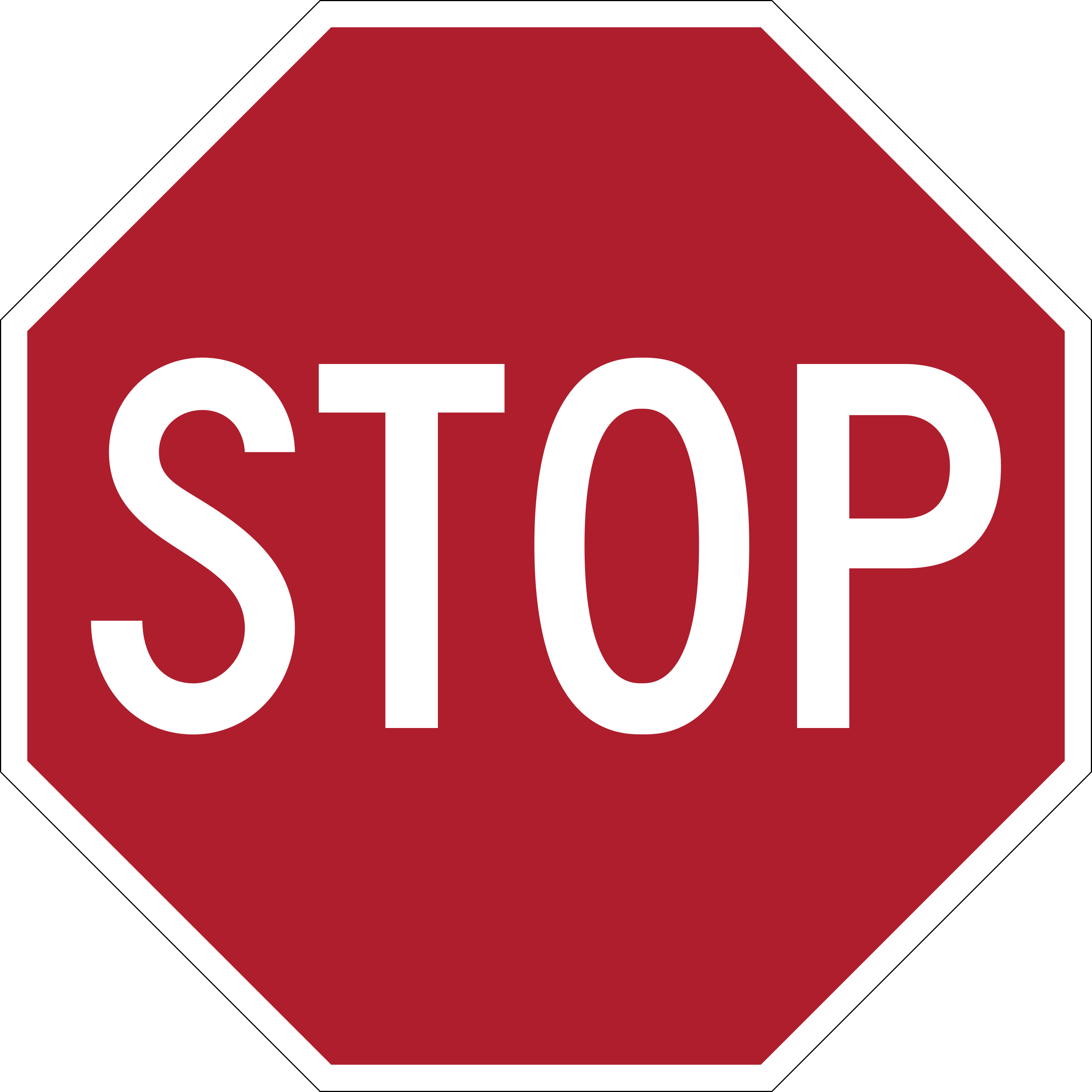
Question 1You come to a red, eight-sided sign with white letters. What must you do?
Show the answer
Answer: C — Come to a complete stop without going past the crosswalk, then go only when it is safe.
The octagon is the STOP sign, the only eight-sided sign on the road. You must bring the car to a complete stop, not going beyond the crosswalk; if you cannot see, move forward cautiously to where you can and go only when it is safe.
Checked against: Tennessee Comprehensive Driver License Manual, Section B-3 Traffic Signs, Signals and Markings (p. 36)
-
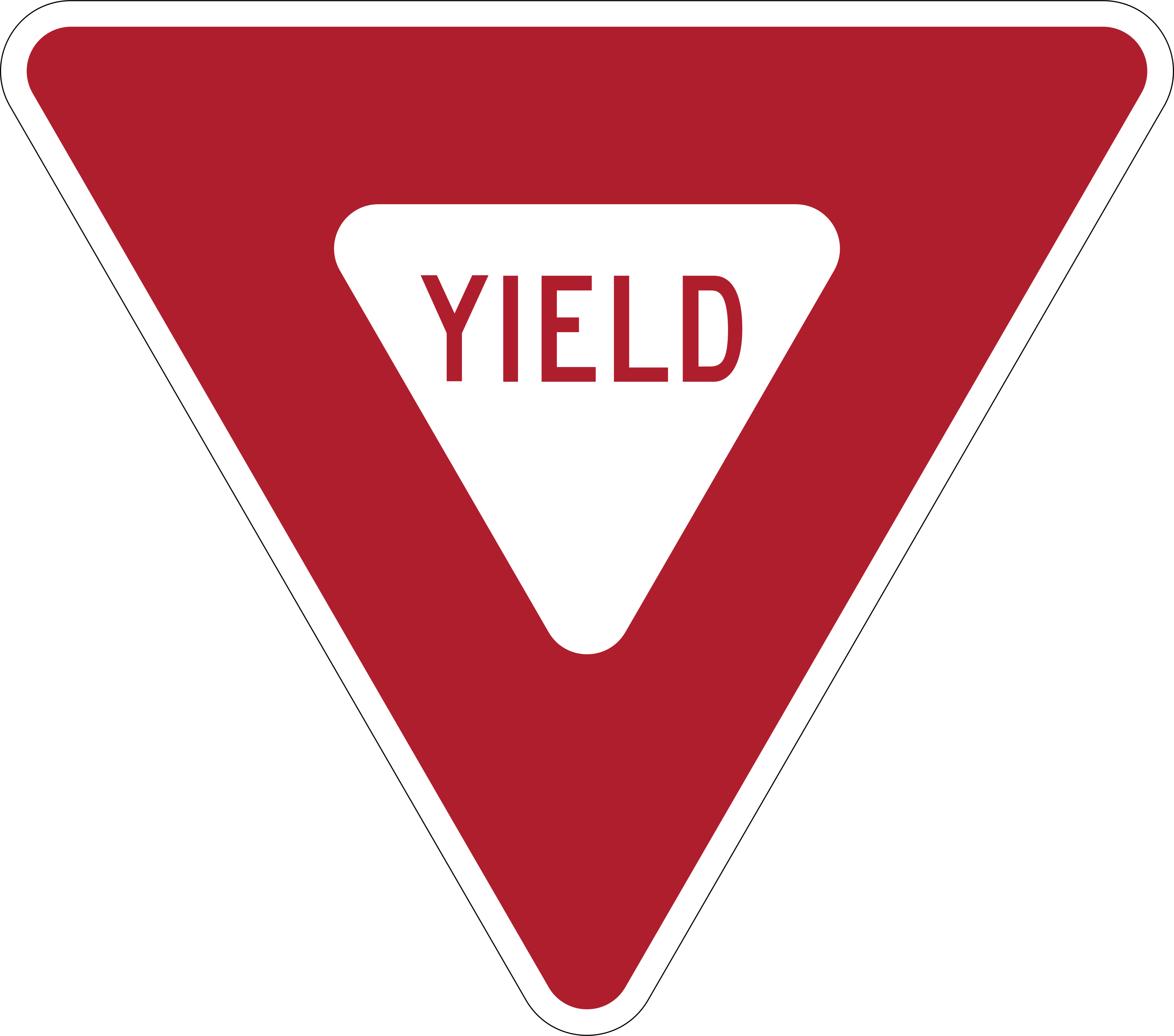
Question 2You approach an intersection with a triangular YIELD sign. No vehicles are coming on the other road. What does the manual say you may do?
Show the answer
Answer: A — Slow down and enter the intersection with caution; a complete stop is not required.
At a YIELD sign you must stop and wait if vehicles are approaching on the other road. If no cars are coming you need not come to a complete stop, but you must slow down and enter with caution. Always stop when traffic is heavy.
Checked against: Tennessee Comprehensive Driver License Manual, Section B-3 Traffic Signs, Signals and Markings (p. 36)
-
Question 3A round yellow sign with a black X and the letters RR tells you that:

Show the answer
Answer: D — You are approaching a railroad grade crossing and must slow down and be ready to stop.
The circular sign always means a railroad crossing is ahead. Slow down and be ready to stop; it is up to you to stop if a train is coming, and you should never try to beat the train.
Checked against: Tennessee Comprehensive Driver License Manual, Section B-3 Traffic Signs, Signals and Markings (p. 36)
-
Question 4At a traffic light you see a flashing yellow arrow pointing left. What may you do?
Show the answer
Answer: B — Turn left after yielding to oncoming traffic and to bicyclists and pedestrians in the crosswalk.
A flashing yellow arrow is a permissive turn: you may turn left, but only after yielding to all oncoming traffic and to bicyclists and pedestrians, waiting for a safe gap.
Checked against: Tennessee Comprehensive Driver License Manual, Section B-3 Traffic Signs, Signals and Markings (p. 41)
-
Question 5The center of a two-lane road has a solid yellow line and a broken yellow line. The broken line is on your side. What does this mean?
Show the answer
Answer: B — You are in a passing zone and may pass when it is safe and no oncoming traffic is present.
When the broken yellow line is on your side you are in the passing zone and may pass if it is safe, returning to your side before the zone ends. If the solid line is on your side, you may not pass.
Checked against: Tennessee Comprehensive Driver License Manual, Section B-3 Traffic Signs, Signals and Markings (p. 43)
-
Question 6In Tennessee, your headlights must be on during which period at night?
Show the answer
Answer: A — From 30 minutes after sunset until 30 minutes before sunrise.
Headlights must be turned on 30 minutes after sunset until 30 minutes before sunrise, and also whenever you cannot see persons or vehicles clearly 200 feet ahead or your wipers are in constant use.
Checked against: Tennessee Comprehensive Driver License Manual, Section B-4 Rules of the Road (p. 45)
-
Question 7Two vehicles arrive at an ALL-WAY stop intersection at the same time. Which vehicle should go first?
Show the answer
Answer: C — The vehicle on the right.
At all-way stops the vehicle that reaches the intersection first goes first. If more than one vehicle arrives at the same time, yield the right-of-way to the vehicle on the right.
Checked against: Tennessee Comprehensive Driver License Manual, Section B-4 Rules of the Road (p. 54)
-
Question 8An ambulance using its siren and flashing lights is coming toward you on a two-lane road. What does Tennessee law require?
Show the answer
Answer: A — Pull to a position as close as possible to the right edge or curb, stop and stay stopped until it has passed.
When an emergency vehicle approaches, all traffic meeting or being overtaken must yield, drive to a position parallel to and as close as possible to the right-hand edge or curb, and stop until it has passed or an officer directs you to move.
Checked against: Tennessee Comprehensive Driver License Manual, Section B-4 Rules of the Road (p. 54)
-
Question 9You meet a school bus stopped on a two-lane road with red lights flashing and its stop arm extended. What must you do?
Show the answer
Answer: D — Stop and remain stopped until the stop arm is pulled back and the bus resumes motion.
Any driver meeting or overtaking a school or church bus with its red stop lights flashing must come to a complete stop while the stop arm is extended, and remain stopped until the arm is pulled back and the bus resumes motion.
Checked against: Tennessee Comprehensive Driver License Manual, Section B-4 Rules of the Road (p. 51)
-
Question 10How close to a fire hydrant may you legally park?
Show the answer
Answer: B — No closer than 15 feet.
It is illegal to park within 15 feet of a fire hydrant. Other no-parking distances include 20 feet from a crosswalk, 30 feet from a traffic signal or stop sign and 50 feet from a railroad crossing.
Checked against: Tennessee Comprehensive Driver License Manual, Section B-4 Rules of the Road (p. 65)
-
Question 11At what blood alcohol concentration (BAC) is a driver 21 or older always considered legally intoxicated in Tennessee?
Show the answer
Answer: B — 0.08 percent or higher.
In Tennessee, as in most states, .08 is the level of intoxication that is always illegal. Lower levels apply to drivers under 21, and a driver can be convicted of DUI below .08 if impaired.
Checked against: Tennessee Comprehensive Driver License Manual, Section B-7 Alcohol, Other Drugs and Driving (p. 79)
-
Question 12What is the only thing that can sober up a person who has been drinking?
Show the answer
Answer: A — Time.
The liver can only oxidize about one drink per hour, and this rate cannot be increased by coffee, exercise, a cold shower or anything else. Only time can sober a person who has been drinking.
Checked against: Tennessee Comprehensive Driver License Manual, Section B-7 Alcohol, Other Drugs and Driving (p. 79)
-
Question 13A 17-year-old driver is found driving with a BAC of 0.02 percent. What is the result under Tennessee law?
Show the answer
Answer: C — Conviction of underage driving while impaired, with loss of license for one year and a $250 fine.
A person at least 16 but not yet 21 found driving with a BAC of .02 percent, or under the influence, is convicted of underage driving while impaired: loss of license for one year, a $250 fine and sometimes public service work.
Checked against: Tennessee Comprehensive Driver License Manual, Section B-7 Alcohol, Other Drugs and Driving (p. 83)
-
Question 14What does Tennessee's Implied Consent law mean?
Show the answer
Answer: A — By driving in Tennessee you have agreed to be tested for alcohol or drugs if an officer has reasonable grounds.
By law, when you drive in Tennessee you have given consent to a test of the alcohol or drug content of your blood when requested by an officer with reasonable grounds. Refusing after arrest will likely lead to a 12-month suspension.
Checked against: Tennessee Comprehensive Driver License Manual, Section B-7 Alcohol, Other Drugs and Driving (p. 81)
-
Question 15How do the penalties for driving under the influence of drugs, including prescription drugs, compare with those for alcohol?
Show the answer
Answer: D — They are the same as for alcohol.
The penalties for a DUI are the same whether the driver was drinking alcohol or taking drugs, even prescription or over-the-counter drugs. A prescription is no defense for driving under the influence.
Checked against: Tennessee Comprehensive Driver License Manual, Section B-7 Alcohol, Other Drugs and Driving (p. 81)
-
Question 16What is the minimum following distance recommended by the Tennessee manual in normal conditions, and how should it change in bad weather or at night?
Show the answer
Answer: B — At least two seconds, increased to at least four seconds in bad weather, at night or on high-speed interstates.
Use the two-second rule: count from when the car ahead passes a fixed point. During bad weather, higher-speed interstate driving, night driving and when following a motorcycle, allow a minimum of four seconds.
Checked against: Tennessee Comprehensive Driver License Manual, Section B-4 Rules of the Road (p. 49)
-
Question 17Your car starts to hydroplane on a wet road. What should you do?
Show the answer
Answer: B — Slow down gradually by letting up on the gas; do not slam on the brakes.
If your vehicle starts to hydroplane, slow down gradually by letting up on the gas and don't slam on the brakes. Hydroplaning removes the traction needed to steer and brake, and stopping distances may triple.
Checked against: Tennessee Comprehensive Driver License Manual, Section B-6 Driving at Night and in Inclement Weather (p. 76)
-
Question 18In a vehicle with air bags, where is the safest place for children 12 and under to ride?
Show the answer
Answer: D — In the back seat, properly restrained.
Children 12 and under are safer in the back seat. Air bags pose a severe risk to them, and children are safer properly restrained in the rear seat whether or not the vehicle has a passenger air bag.
Checked against: Tennessee Comprehensive Driver License Manual, Section B-2 Tennessee Safety Belt Laws (p. 33)
-
Question 19How should the head restraint on your seat be adjusted?
Show the answer
Answer: A — Even with the back of your head, to help prevent whiplash if you are hit from behind.
Properly adjust the head restraint to a level even with the back of your head. Head restraints are designed to prevent whiplash if you are hit from behind.
Checked against: Tennessee Comprehensive Driver License Manual, Section B-1 Getting Familiar With Your Vehicle (p. 27)
-
Question 20You are driving behind a large truck. If you cannot see the truck's side mirrors, what does that mean?
Show the answer
Answer: C — The truck driver cannot see you.
If you cannot see the side mirrors of the truck or bus you are following, its driver cannot see you. You are also too close to see the road ahead and at greater risk of a rear-end collision.
Checked against: Tennessee Comprehensive Driver License Manual, Section B-4 Rules of the Road (p. 64)
Official passing standard: Online knowledge test (ages 15 to 17): minimum score of 80%, which is 24 of 30 questions. The department does not publish the number of questions, time limit or passing score for the test taken at a Driver Services Center.
Tennessee permit test format
| Tennessee permit test | Official rule |
|---|---|
| Number of questions (online test, ages 15-17) | 30 questions on the online test. For the test at a Driver Services Center, the manual says only that it is multiple choice and taken on computerized testing machines; no official question count is published source |
| Time limit (online test) | 60 minutes on the online test (no time limit published for the test at a Driver Services Center) source |
| Passing score (online test) | Online test: minimum 80% (24 of 30 correct). No passing score published for the test at a Driver Services Center source |
| What the test covers | Based on Sections B and C of the manual; roughly 25% each: traffic signs and signals, safe driving principles, rules of the road, and drugs and alcohol (by law at least 25% of questions deal with alcohol and drugs) source |
| Vision screening | At least 20/40 in each eye individually and both eyes together, with or without glasses or contacts source |
| Minimum age for a learner permit | 15 source |
| Learner permit rules (under 18) | Drive only with a licensed driver 21 or older in the front seat; no driving from 10 P.M. to 6 A.M.; driver and passengers must wear a safety belt source |
| Before the road test (under 18) | Hold the learner permit at least 180 days, be at least 16, and have 50 hours of supervised driving including 10 at night, certified on the 50-Hour Certification form source |
| Online test for teens | Ages 15 to 17 may take the knowledge test online, proctored by a parent or legal guardian using the Tennessee Proctor ID app source |
| Retakes | At a Driver Services Center: wait at least one day after failing, and pay the $2 application fee each time you fail. Online: wait 24 hours; maximum of two online attempts source |
| Fees | Learner permit (PD) under 18: $10.50 for 1 year; 18 and over: $5.50. Class D license: $28.00 (8 years). County Clerk partners add a $4.00 administrative fee source |
| Languages | Online test: English and Spanish. At Driver Services Centers the manual lists Spanish, Korean and Japanese as alternate languages; interpreters are not allowed source |
| Handbook | Tennessee Comprehensive Driver License Manual (PDF printed March 2025, authorization MT3Q28; file updated April 2026) source |
Checked on the official sources on September 30, 2026. Rules change: always confirm on the official site before test day.
What the Tennessee permit test is
In Tennessee, the knowledge test is the first step toward a driver license. You take it with a vision screening, and if you pass you can get a Class PD learner permit and start practicing with a supervising driver. You must be at least 15 to get a learner permit. Adults applying for a first license also take the Class D knowledge test and a vision screening.
The test is run by the Driver Services Division of the Tennessee Department of Safety and Homeland Security. Its questions are based on Sections B and C of the Tennessee Comprehensive Driver License Manual, which you can download free.
Format and scoring
| Online test (ages 15 to 17) | At a Driver Services Center | |
|---|---|---|
| Questions | 30 | Multiple choice; number not published |
| Time limit | 60 minutes | Not published |
| To pass | 80% minimum, which is 24 of 30 | Not published |
| Languages | English and Spanish | English, Spanish, Korean or Japanese |
The 30-question, 60-minute, 80% format is published only on the department's page for the online test. The manual describes the test taken at a Driver Services Center as multiple choice, but it gives no question count, time limit or passing score, and we found no other official page that does. If you test in person, ask the center. Everyone also takes a vision screening: at least 20/40 in each eye and both eyes together, with or without glasses or contacts.
The manual says to expect the test to be split roughly into four equal parts: traffic signs and signals (25%), safe driving principles (25%), rules of the road (25%) and drugs and alcohol (25%). The alcohol share is not an accident: by law, at least 25 percent of the questions must deal with alcohol and drugs. On a 30-question test such as the online one, that means at least 8 questions on alcohol and drugs, with only six misses allowed in total, so chapter B-7 on alcohol and other drugs is worth studying closely.
At Driver Services Centers the test is taken on computerized testing machines. According to the manual, centers also offer it in Spanish, Korean or Japanese. You may use a translation dictionary with no notes in it, but phones, electronic dictionaries and interpreters are not allowed. Any cheating means automatic failure and no retest for 30 days.
Taking the test online (ages 15 to 17)
Teens aged 15 to 17 can take the knowledge test online, with a parent or legal guardian acting as proctor through the Tennessee Proctor ID app. The main rules from the department's page:
- The proctor installs the app on their own phone or tablet, not the applicant's. One parent or guardian can proctor for up to five applicants.
- You take the test on a computer, laptop or tablet. Cell phones are not allowed for testing.
- You must stay on the test screen. Leaving the test window means automatic failure.
- At the 30-minute mark, the proctor scans a QR code to confirm identity again. If you finish before 30 minutes, you skip this step.
- No help, notes or electronic devices are allowed during the test.
- If you fail, you wait 24 hours before retesting, and you can take the online test a maximum of two times.
The department may still require you to retake the test at a Driver Services Center even if you passed online. You still visit a center for the vision screening and your documents.
Step by step: from permit to license (under 18)
- Study the manual. Download the Comprehensive Driver License Manual. The department also links free online practice questions.
- Apply online and get documents pre-approved. You can complete the application in e-Services. Allow up to five business days for pre-approval, then bring the original documents anyway.
- Prepare the extra paperwork for minors. A parent or legal guardian signs the minor/teenage affidavit and financial responsibility form, and you bring proof of school attendance signed no more than 30 days before you apply.
- Take the knowledge test online or at a Driver Services Center, pass the vision screening and pay the fee.
- Practice under the learner permit rules. You may drive only with a licensed driver 21 or older in the front seat, never between 10 P.M. and 6 A.M., and everyone in the car must wear a safety belt.
- Log your practice. You need 50 hours of behind-the-wheel driving, including 10 at night, certified by a parent, guardian or driving instructor on the 50-Hour Certification form.
- Take the road test. You must be at least 16 and have held the permit for at least 180 days. Someone 21 or older with a valid license must come with you to the center. Passing gives you an Intermediate Restricted license, which comes with its own limits on passengers and night driving.
The graduated license steps do not apply to anyone 18 or older, or to those under 18 who have graduated high school or earned a GED.
Fees
From the department's fee page:
- Learner permit (PD) under 18: $10.50, valid 1 year
- Learner permit (PD) 18 and over: $5.50, valid 1 year
- Class D license: $28.00, valid 8 years
- Intermediate Restricted license (under 18): $24.50
County Clerk partners add a $4.00 administrative fee. At a Driver Services Center you also pay the $2 application fee each time you take a test and fail.
If you fail
At a Driver Services Center there is a mandatory one-day wait after failing a knowledge test, and you cannot retake it the same day. Bring all of your original documents back with you. The same one-day wait applies after a second or later failure.
Tennessee rules that come up often
These points come from the manual and are specific to Tennessee:
- Headlights: on from 30 minutes after sunset to 30 minutes before sunrise, and whenever your wipers are in constant use.
- Speed: 55 mph on state and federal highways unless posted. On interstates the legal maximum is 70 mph, you may not drive under 55 mph in the left-most lane in normal traffic, and the minimum in the right lanes is 45 mph.
- School buses: stop for flashing red lights from both directions. A center turn lane does not count as a barrier.
- Railroad crossings: when a train is coming, stop between 15 and 50 feet from the tracks.
- Bicycles: leave at least 3 feet when passing.
- Alcohol: .08 is always illegal. Drivers under 21 with a BAC of .02 lose their license for one year and pay a $250 fine. A first DUI brings at least 48 hours in jail and a one-year revocation.
- Phones: under the hands-free law, a driver may not hold a phone with any part of the body.
How to prepare
Read Sections B and C once from start to finish. The end-of-chapter sample questions and answer key show the style. Then go back to chapter B-3 and learn every sign by its shape and color. Spend extra time on chapter B-7 (alcohol and drugs), because it makes up about a quarter of the test. Numbers cost the most points: distances (50 feet to signal, 15 feet from a hydrant, 15 to 50 feet from a railroad crossing), speed limits, BAC levels and DUI penalties. Put them on one page and review it before the test.
Our practice questions are original and written from the current manual, and each one notes the section of the manual it comes from. Our full-length tests use the online test's format (30 questions, 60 minutes, 80% to pass) because it is the only format the department publishes. They are for practice only and do not replace the manual. The Department of Safety decides what is on your test.
Frequently asked questions
How many questions are on the Tennessee permit test and what score do I need?
The department publishes these figures only for the online knowledge test for ages 15 to 17: 30 questions, a 60-minute limit and a minimum score of 80%, which is 24 correct answers. For the test at a Driver Services Center, the manual says only that it is a multiple-choice test on computerized testing machines; it does not give a question count, time limit or passing score. Source
Can I take the Tennessee knowledge test online?
Yes, if you are 15 to 17. A parent or legal guardian must act as proctor using the Tennessee Proctor ID app on their own device, and you take the test on a computer, laptop or tablet (not a phone). The department may still require you to retake the test at a Driver Services Center. Source
What happens if I fail?
At a Driver Services Center you must wait at least one day before trying again, and you pay the $2 application fee each time you take a test and fail. If you fail the online test you must wait 24 hours, and you may take the online test a maximum of two times. Source
What is on the test?
The test uses information from Sections B and C of the Tennessee Comprehensive Driver License Manual. Expect roughly equal shares of traffic signs and signals, safe driving principles, rules of the road, and drugs and alcohol; by law at least 25% of the questions deal with alcohol and drugs. Source
How long must I hold my learner permit before the road test?
If you are under 18, you must hold the learner permit for at least 180 days, be at least 16 and have 50 hours of behind-the-wheel practice including 10 hours at night, certified by a parent, guardian or driving instructor. Source
What are the rules while I have a learner permit?
You may drive only with a licensed driver age 21 or older riding in the front seat, you may not drive between 10 P.M. and 6 A.M., and the driver and all passengers must wear a safety belt. Source
In which languages can I take the test?
The online test is available in English and Spanish. The manual says Driver Services Centers with computerized testing also offer Spanish, Korean and Japanese; you may use a translation dictionary with no notes, but interpreters are not allowed. Source
Other states and road signs
California permit practice test
California DMV
Texas permit practice test
Texas Department of Public Safety
Florida permit practice test
Florida Department of Highway Safety and Motor Vehicles (FLHSMV)
New York permit practice test
New York State DMV
Pennsylvania permit practice test
PennDOT Driver and Vehicle Services
Ohio permit practice test
Ohio Bureau of Motor Vehicles (BMV)
North Carolina permit practice test
North Carolina Division of Motor Vehicles (NCDMV)
Georgia permit practice test
Georgia Department of Driver Services (DDS)
New Jersey permit practice test
New Jersey Motor Vehicle Commission (NJ MVC)
Virginia permit practice test
Virginia Department of Motor Vehicles (DMV)
Illinois permit practice test
Illinois Secretary of State, Driver Services
Michigan permit practice test
Michigan Department of State (Secretary of State)
Road signs practice test
Shapes, colors and meanings
Sources
- Tennessee Comprehensive Driver License Manual (PDF, 135 pages; back cover: March 2025, authorization MT3Q28; file modified April 2026; notice says information current as of July 1, 2022) — Tennessee Department of Safety and Homeland Security (checked September 30, 2026)
- Teen/Graduated Driver License — Tennessee Department of Safety and Homeland Security (checked September 30, 2026)
- Driver License Knowledge Permit Test Online — Tennessee Department of Safety and Homeland Security (checked September 30, 2026)
- Driver License Fees — Tennessee Department of Safety and Homeland Security (checked September 30, 2026)
- Adult First-Time Drivers — Tennessee Department of Safety and Homeland Security (checked September 30, 2026)
passmock is an independent practice resource. It is not affiliated with, endorsed by or connected to the Tennessee Department of Safety and Homeland Security. Our questions are original practice questions written from the official test description and study materials; they are not questions from the real test.