Free New Jersey MVC knowledge test practice test (20 questions)
Click an answer to see instantly if it is right, with the explanation. No sign-up, no email.
-
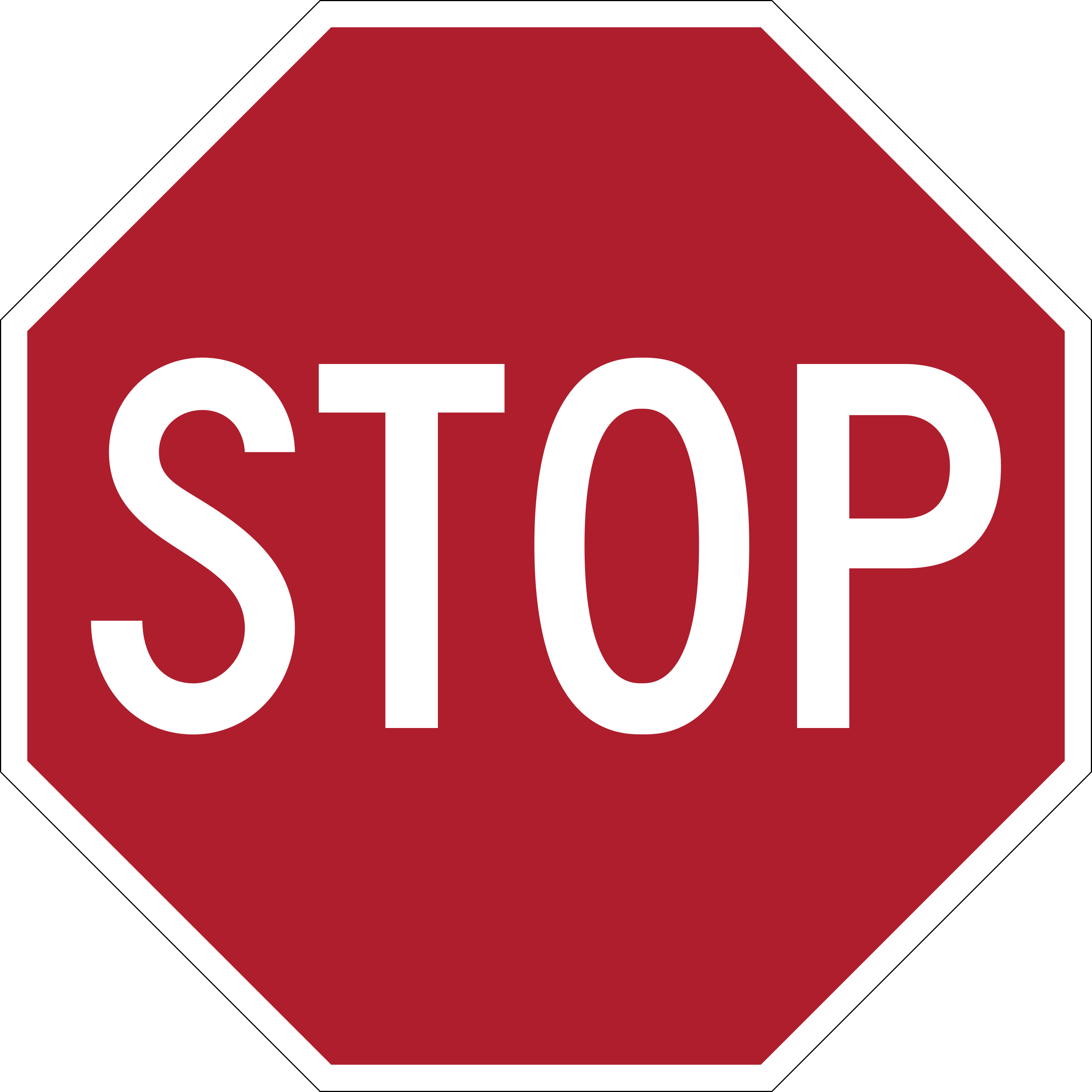
Question 1You come to a red, eight-sided sign with white letters. What must you do?
Show the answer
Answer: D — Come to a complete stop, yield to pedestrians and close traffic, then go when safe.
This is a STOP sign, the only octagon. The manual says to stop completely within five feet of the nearest crosswalk or stop line, then enter only after yielding to pedestrians and to traffic close enough to be a hazard.
Checked against: NJ Driver Manual (2026), Chapter 4 Safe Driving Rules and Regulations — Intersections — Controlled, p. 67
-
Question 2In New Jersey, which kind of sign uses a yellow, five-sided (pentagon) shape?
Show the answer
Answer: B — School signs.
The manual's sign chart lists the yellow pentagon for school signs. The yellow pennant is for no-passing zones, the round yellow sign warns of a railroad crossing, and service signs are blue.
Checked against: NJ Driver Manual (2026), Chapter 11 Appendix: Driver Safety — Appendix: Driver Safety — sign color and shape chart, p. 214
-
Question 3An orange, diamond-shaped sign is used for which purpose?
Show the answer
Answer: A — Construction and maintenance warnings.
Orange diamonds warn of construction and maintenance work. The manual adds that traffic fines are doubled in New Jersey work zones.
Checked against: NJ Driver Manual (2026), Chapter 11 Appendix: Driver Safety — Appendix: Driver Safety — sign color and shape chart, p. 214
-
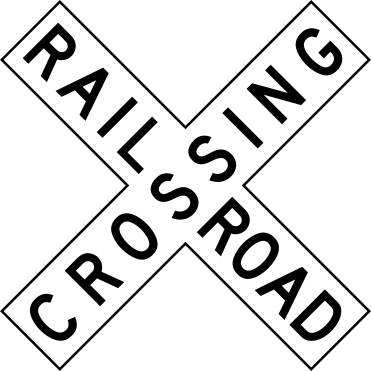
Question 4What does the white, X-shaped railroad crossbuck sign require you to do?
Show the answer
Answer: C — Treat it like a YIELD sign and always yield the right-of-way to trains.
The manual says the crossbuck means the same as a Yield sign: motorists must always yield to trains, which cannot swerve to avoid them.
Checked against: NJ Driver Manual (2026), Chapter 11 Appendix: Driver Safety — Appendix: Driver Safety — Regulatory signs (Cross buck), p. 216
-
Question 5What is the youngest age at which a New Jersey resident can get a special learner permit?
Show the answer
Answer: D — 16, when enrolled in an approved behind-the-wheel driver training course.
The Early Bird Road (GDL Option A) starts at age 16 with parent or guardian consent and enrollment in an approved behind-the-wheel course. Without a course, the examination permit starts at 17.
Checked against: NJ Driver Manual (2026), Chapter 1 The New Jersey Driver License System — Graduated Driver License — GDL Option A, p. 15
-
Question 6A GDL permit holder under 21 must complete what supervised practice before the road test?
Show the answer
Answer: A — At least six months, including at least 50 hours of practice driving, 10 of them in darkness.
The manual says GDL permit holders under 21 need at least six months of supervised practice with at least 50 practice driving hours, including 10 during darkness, certified on form BA-CSD by a parent, guardian or supervising driver.
Checked against: NJ Driver Manual (2026), Chapter 2 New Jersey Driver Testing — Road Test, p. 34
-
Question 7What must you do at a flashing red traffic light?
Show the answer
Answer: B — Stop, yield to traffic and pedestrians, and go only when it is safe.
A flashing red light means the same as a stop sign: stop, yield to traffic and pedestrians, then proceed when safe.
Checked against: NJ Driver Manual (2026), Chapter 11 Appendix: Driver Safety — Appendix: Driver Safety — Traffic signals, p. 212
-
Question 8A pedestrian is walking in a marked crosswalk in front of you. What does New Jersey law require?
Show the answer
Answer: C — Come to a complete stop and stay stopped until the pedestrian has cleared your lane and the next lane in your direction.
The manual says you must stop, not just slow down or yield, and remain stopped until the pedestrian has safely cleared your lane and the adjacent lane in the same direction.
Checked against: NJ Driver Manual (2026), Chapter 4 Safe Driving Rules and Regulations — Pedestrians in a Crosswalk, p. 66
-
Question 9Unless a different limit is posted, what is the speed limit in New Jersey school zones and business or residential districts?
Show the answer
Answer: D — 25 mph.
New Jersey's statewide limits, unless otherwise posted, are 25 mph in school zones and business or residential districts, 35 mph in suburban business and residential districts, and 50 mph on non-posted rural roads.
Checked against: NJ Driver Manual (2026), Chapter 4 Safe Driving Rules and Regulations — Speed Control, p. 62
-
Question 10How far ahead must you signal before making a turn?
Show the answer
Answer: C — At least 100 feet.
State law requires you to move to the proper lane and signal at least 100 feet before any turn, and to cancel the signal afterward.
Checked against: NJ Driver Manual (2026), Chapter 3 Driver Responsibility — Turning, p. 55
-
Question 11A school bus has stopped with its red lights flashing on a two-lane road. How far away must you stop?
Show the answer
Answer: B — At least 25 feet.
State law requires motorists behind or approaching a stopped school bus to stop at least 25 feet away on a two-lane road, a multi-lane road separated only by lines, or a private road.
Checked against: NJ Driver Manual (2026), Chapter 4 Safe Driving Rules and Regulations — Stop for School Buses, p. 77
-
Question 12When does New Jersey law require you to use your headlights?
Show the answer
Answer: A — From one-half hour after sunset to one-half hour before sunrise, when visibility is 500 feet or less, and whenever your wipers are on.
Headlights are required from half an hour after sunset to half an hour before sunrise, when visibility is 500 feet or less, when using windshield wipers, and in fog, mist or smoke.
Checked against: NJ Driver Manual (2026), Chapter 4 Safe Driving Rules and Regulations — Using Headlights, p. 83
-
Question 13Under New Jersey's seat belt law, who in a passenger car must wear a seat belt?
Show the answer
Answer: A — The driver and every passenger.
State law requires the driver and all passengers of a passenger vehicle to wear a seat belt. Not buckling up is a primary offense for the driver, front-seat passengers and children under 18.
Checked against: NJ Driver Manual (2026), Chapter 3 Driver Responsibility — Buckle up — New Jersey Seat Belt Law, p. 40
-
Question 14For normal driving, where should your hands be on the steering wheel?
Show the answer
Answer: C — At the 9 and 3 o'clock positions on the outside rim.
The manual recommends gripping the outside rim at 9 and 3 o'clock with thumbs along the face of the wheel. This lowers the risk of hand, wrist or arm injury if the air bag deploys.
Checked against: NJ Driver Manual (2026), Chapter 3 Driver Responsibility — Steering — Hand position, p. 51
-
Question 15Using the three-seconds-plus rule, how much following time should you allow in bad weather?
Show the answer
Answer: B — Four or more seconds.
Count at least three seconds behind the vehicle ahead in good conditions. During bad weather, increase the interval to four or more seconds.
Checked against: NJ Driver Manual (2026), Chapter 5 Defensive Driving — Keep a Safe Distance — Three seconds-plus rule, p. 95
-
Question 16Which type of distraction takes your mind or attention off the road, even when your eyes and hands are on the task of driving?
Show the answer
Answer: D — Cognitive.
The manual lists four types of distraction: visual (eyes off the road), manual (hands off the wheel), cognitive (mind off the road) and auditory (sounds that reduce attention).
Checked against: NJ Driver Manual (2026), Chapter 5 Defensive Driving — Distractions, p. 92
-
Question 17At about what speed can tires start to hydroplane on a wet road?
Show the answer
Answer: C — About 35 mph.
Tires can start to ride up on a film of water at about 35 mph, and the chance increases with speed. After 55 mph they may leave the road surface completely.
Checked against: NJ Driver Manual (2026), Chapter 5 Defensive Driving — Road Conditions — Hydroplaning, p. 97
-
Question 18The rear of your car starts to skid to the right. What should you do?
Show the answer
Answer: A — Take your foot off the gas and steer in the direction the rear is skidding, without oversteering.
Ease off the gas and turn in the direction the rear of the vehicle is skidding, without oversteering, while looking where you want to go. Avoid braking during a side skid.
Checked against: NJ Driver Manual (2026), Chapter 5 Defensive Driving — Reacting to Driving Problems — Skids, p. 104
-
Question 19In New Jersey, it is illegal for a driver 21 or older to drive with a blood alcohol concentration (BAC) of:
Show the answer
Answer: D — 0.08 percent or higher.
It is illegal to drive under the influence or with a BAC of 0.08 percent or higher. For drivers under 21, the limit is 0.01 percent.
Checked against: NJ Driver Manual (2026), Chapter 6 Drinking, Drugs, and Health — How Much is Too Much, p. 115
-
Question 20You want to pass a bicyclist on a single-lane road and cannot move over a lane. What does the Safe Passing Law require?
Show the answer
Answer: B — Leave at least 4 feet; if that is not possible, slow to 25 mph and be ready to stop until it is safe to pass.
Under the Safe Passing Law, move over a lane when possible; otherwise leave at least 4 feet, or slow to 25 mph and be prepared to stop until you can pass safely.
Checked against: NJ Driver Manual (2026), Chapter 8 Sharing the Road with Others — Safe Passing Law (Vulnerable Road Users), p. 146
Official passing standard: 80 percent: at least 40 of the 50 questions correct.
New Jersey MVC knowledge test format
| New Jersey MVC knowledge test | Official rule |
|---|---|
| Number of questions | 50 questions, plus a survey question about organ donation source |
| Passing score | 80 percent: 40 of the 50 questions correct source |
| Vision test | 20/50 visual acuity, with or without corrective lenses source |
| Languages | Written test in English, Arabic, Chinese (Mandarin), French, Spanish, Korean, Polish, Portuguese, Russian, Japanese, Hindi, Albanian and Turkish; oral test in English and Spanish; MVC-arranged interpreter if your language is not offered source |
| Retake after failing | You can re-test in 7 days (road test: 14 days) source |
| Minimum age | 16 for a special learner permit (enrolled in an approved behind-the-wheel course); 17 for an examination permit; 17 for a probationary license; 18 for a basic license source |
| Permit fee | $10 for a student (special) learner's permit or an examination permit source |
| Supervised driving (under 21) | At least 6 months, including at least 50 hours of practice driving with 10 in darkness, certified on form BA-CSD source |
| Supervised driving (21 and older) | At least 3 months before the road test source |
| Behind-the-wheel course (special learner permit) | Six full hours of instruction in a dual-controlled vehicle; the instructor buys the permit source |
| GDL restrictions (under 21) | No driving 11:01 p.m. to 5:00 a.m.; no hand-held or hands-free phones; supervising driver 21+ with 3 years' experience; limited passengers; red decals on both plates ($4 a pair) source |
| Permit validity | Two years to finish the steps and get your probationary license, or you must get a new permit source |
| Probationary license | Fee $6; at least one year of unsupervised driving before upgrading to a basic license at 18 or older source |
| Driver Manual edition | New Jersey Driver Manual 2026 (MVC manuals page: revised 09/26) source |
Checked on the official sources on September 30, 2026. Rules change: always confirm on the official site before test day.
What the New Jersey knowledge test is
New Jersey does not have a "DMV". Licenses are issued by the New Jersey Motor Vehicle Commission (MVC), and every first-time driver goes through its Graduated Driver License (GDL) program in phases: a permit, a probationary license, then a basic license (NJ Driver Manual, chapter 1).
The knowledge test is the first real step. You take it with a vision test at an MVC driver testing center, and once you pass, your permit is validated for supervised practice driving. To prepare, the MVC tells you to study the New Jersey Driver Manual, which covers the license system, rules of the road, safe and defensive driving, alcohol and drugs, penalties, sharing the road and road signs.
Format and scoring
| New Jersey knowledge test | |
|---|---|
| Questions | 50, plus one survey question about organ donation |
| To pass | 80 percent, or 40 of the 50 questions correct |
| Vision test | 20/50, with or without corrective lenses |
| If you fail | re-test in 7 days |
| Languages | 13 written languages; oral test in English and Spanish |
The written test is offered in English, Arabic, Chinese (Mandarin), French, Spanish, Korean, Polish, Portuguese, Russian, Japanese, Hindi, Albanian and Turkish. If your language is not on the list, the MVC can arrange and pay for an interpreter; the manual says to tell the MVC at least two weeks before the date you plan to test. The MVC does not publish a time limit.
Forty out of fifty leaves room for only ten mistakes. The MVC's own sample knowledge test is a good way to see the style of the questions before you start.
The three GDL roads, step by step
Which road you take depends on your age when you start. All the steps below come from chapter 1 of the Driver Manual and the MVC's first driver license page.
Age 16: special learner permit (the "Early Bird Road")
- Be at least 16, have signed parent or guardian consent, and enroll in an approved behind-the-wheel course through a school program or a licensed driving school.
- The approved instructor buys the permit. You pass the knowledge and vision tests and pay the $10 permit fee.
- Complete six full hours of behind-the-wheel instruction in a dual-controlled car. The MVC validates the permit for practice only after the course.
- Practice with a supervising driver for at least six months, then take the road test. You must be at least 17 to receive the probationary license.
Ages 17 to 20: examination permit (the "Young Adult Road")
- Be at least 17 (parent or guardian consent if you are under 18), buy an examination permit and pass the knowledge and vision tests.
- Practice supervised driving for at least six months.
- Pass the road test and get your probationary license.
Age 21 and older: examination permit (the "Adult Road")
- Pass the knowledge and vision tests.
- Practice supervised driving for at least three months.
- Pass the road test.
On every road, the probationary license lasts at least one year of unsupervised driving, and you must be at least 18 to upgrade to a basic license. Once you have your permit, you have two years to finish the steps and get your probationary license, or you must get a new permit.
Supervised practice: the 50-hour rule
If you are under 21, six months of practice is not enough on its own. You need at least 50 hours of practice driving, including 10 hours in darkness, and a parent, guardian or supervising driver must certify them on form BA-CSD. The MVC says only this form is accepted, and that the 50 hours still apply if you got your permit before 21 and apply for the license after turning 21.
Your supervising driver must sit in the front seat, be at least 21, hold a valid New Jersey license and have at least three years of driving experience.
GDL restrictions for drivers under 21
These rules apply to special learner permits, examination permits and probationary licenses (Driver Manual, chapter 1):
- Hours: no driving between 11:01 p.m. and 5:00 a.m., unless you carry a signed letter proving a work or religious need.
- Phones: no hand-held or hands-free phones or other electronic devices.
- Passengers: dependents plus one additional passenger, unless a parent or guardian is in the car.
- Seat belts: you and every passenger must buckle up.
- Decals: two red reflective decals, one on the top left corner of each license plate, $4 a pair.
Breaking a GDL restriction can mean a $100 fine or a suspension. If you are 21 or older, the hour, passenger and decal restrictions do not apply.
Fees
The MVC fee chart lists $10 for a special learner or examination permit, and the Driver Manual's license chart lists $6 for the probationary license and $24 for a standard basic license. GDL decals cost $4 a pair. The manual notes that fees can change, so check the MVC fee page before your appointment.
The road test
You can schedule it once your supervised period is complete. Bring your 6 Points of ID, your validated permit, an accompanying New Jersey driver who is at least 21 and has been licensed for at least three years, and a registered, inspected and insured vehicle with the red decals if you are under 21. The test takes about 10 to 15 minutes and includes driving in reverse, a 3-point turn and parallel parking. If you fail, you must wait at least 14 days before trying again.
New Jersey rules that come up often
- Speed limits unless posted: 25 mph in school, business and residential districts, 35 mph in suburban business and residential districts, 50 mph on non-posted rural roads.
- School buses: stop at least 25 feet away when the red lights flash; on a divided highway across a raised median, slow to 10 mph.
- Pedestrians: stop, not just slow down, for a pedestrian in a crosswalk and stay stopped until they clear your lane and the next one.
- Alcohol: the limit is 0.08 percent, or 0.01 percent for drivers under 21.
- Parking: not within 10 feet of a hydrant, 25 feet of a crosswalk at an intersection, or 50 feet of a stop sign or railroad crossing.
How to prepare
Download the free Driver Manual and read chapters 1 to 8 once, then study the sign chart and sign pages in the appendix until you can name each sign from its shape and color. Numbers are where most points are lost: GDL hours, following distances, parking distances, BAC limits and point values. Write them on one page and review them the day before. Try the MVC's sample test too.
Our practice questions are original, written from the current Driver Manual, and each one gives the chapter and page of the manual it comes from. They are for practice and do not replace the manual. The MVC decides what is on your test.
Frequently asked questions
Is it the DMV or the MVC in New Jersey?
New Jersey's licensing agency is the Motor Vehicle Commission (MVC), not a DMV. You visit a driver testing center with your 6 Points of ID to buy an examination permit, then make an appointment for the knowledge test (with a vision test) at an MVC testing location. Source
How many questions are on the New Jersey knowledge test, and what score do I need?
The test has 50 questions, plus a survey question about organ donation. You must answer 80 percent, or 40 of the 50, correctly. Source
What happens if I fail the knowledge test?
The MVC says that if you fail, you can re-test in 7 days. If you pass, your permit is validated and you can start supervised practice driving. Source
Can I get a permit at 16?
Yes, but only a special learner permit: you must have parent or guardian consent and be enrolled in an approved behind-the-wheel course (six hours in a dual-controlled car with a driving school or school program). The instructor buys the permit. Without a course, the examination permit starts at 17. Source
How many hours of supervised driving do I need?
If you are under 21, at least six months of supervised practice, including at least 50 hours of practice driving with 10 in darkness, certified by a parent, guardian or supervising driver on form BA-CSD. The MVC says the 50 hours still apply if you got your permit under 21 and apply for the license after turning 21. Drivers 21 and older need three months of supervised driving. Source
Which languages can I take the test in?
The written tests are offered in English, Arabic, Chinese (Mandarin), French, Spanish, Korean, Polish, Portuguese, Russian, Japanese, Hindi, Albanian and Turkish, and oral tests in English and Spanish. If your language is not offered, the MVC can arrange an interpreter. Source
Do the GDL rules apply if I am over 21?
Every new driver goes through the GDL phases, but if the examination permit or probationary license holder is 21 or older, the hour, passenger and decal restrictions do not apply. Adults still need a supervising driver while on a permit and three months of supervised practice. Source
Other states and road signs
California permit practice test
California DMV
Texas permit practice test
Texas Department of Public Safety
Florida permit practice test
Florida Department of Highway Safety and Motor Vehicles (FLHSMV)
New York permit practice test
New York State DMV
Pennsylvania permit practice test
PennDOT Driver and Vehicle Services
Ohio permit practice test
Ohio Bureau of Motor Vehicles (BMV)
North Carolina permit practice test
North Carolina Division of Motor Vehicles (NCDMV)
Georgia permit practice test
Georgia Department of Driver Services (DDS)
Virginia permit practice test
Virginia Department of Motor Vehicles (DMV)
Illinois permit practice test
Illinois Secretary of State, Driver Services
Tennessee permit practice test
Tennessee Department of Safety and Homeland Security, Driver Services
Michigan permit practice test
Michigan Department of State (Secretary of State)
Road signs practice test
Shapes, colors and meanings
Sources
- New Jersey Driver Manual, 2026 edition (MVC manuals page: revised 09/26; PDF last modified September 23, 2026) — New Jersey Motor Vehicle Commission (checked September 30, 2026)
- Knowledge Test — New Jersey Motor Vehicle Commission (checked September 30, 2026)
- Sample knowledge test — New Jersey Motor Vehicle Commission (checked September 30, 2026)
- First Driver License/ID — New Jersey Motor Vehicle Commission (checked September 30, 2026)
- Basic Road Test — New Jersey Motor Vehicle Commission (checked September 30, 2026)
- Vision Test — New Jersey Motor Vehicle Commission (checked September 30, 2026)
- License and Permit Fees — New Jersey Motor Vehicle Commission (checked September 30, 2026)
- Graduated Driver License (decals and restrictions) — New Jersey Motor Vehicle Commission (checked September 30, 2026)
- Driver Manuals — New Jersey Motor Vehicle Commission (checked September 30, 2026)
passmock is an independent practice resource. It is not affiliated with, endorsed by or connected to the New Jersey Motor Vehicle Commission (NJ MVC). Our questions are original practice questions written from the official test description and study materials; they are not questions from the real test.