Free Virginia DMV knowledge exam practice test (20 questions)
Click an answer to see instantly if it is right, with the explanation. No sign-up, no email.
-
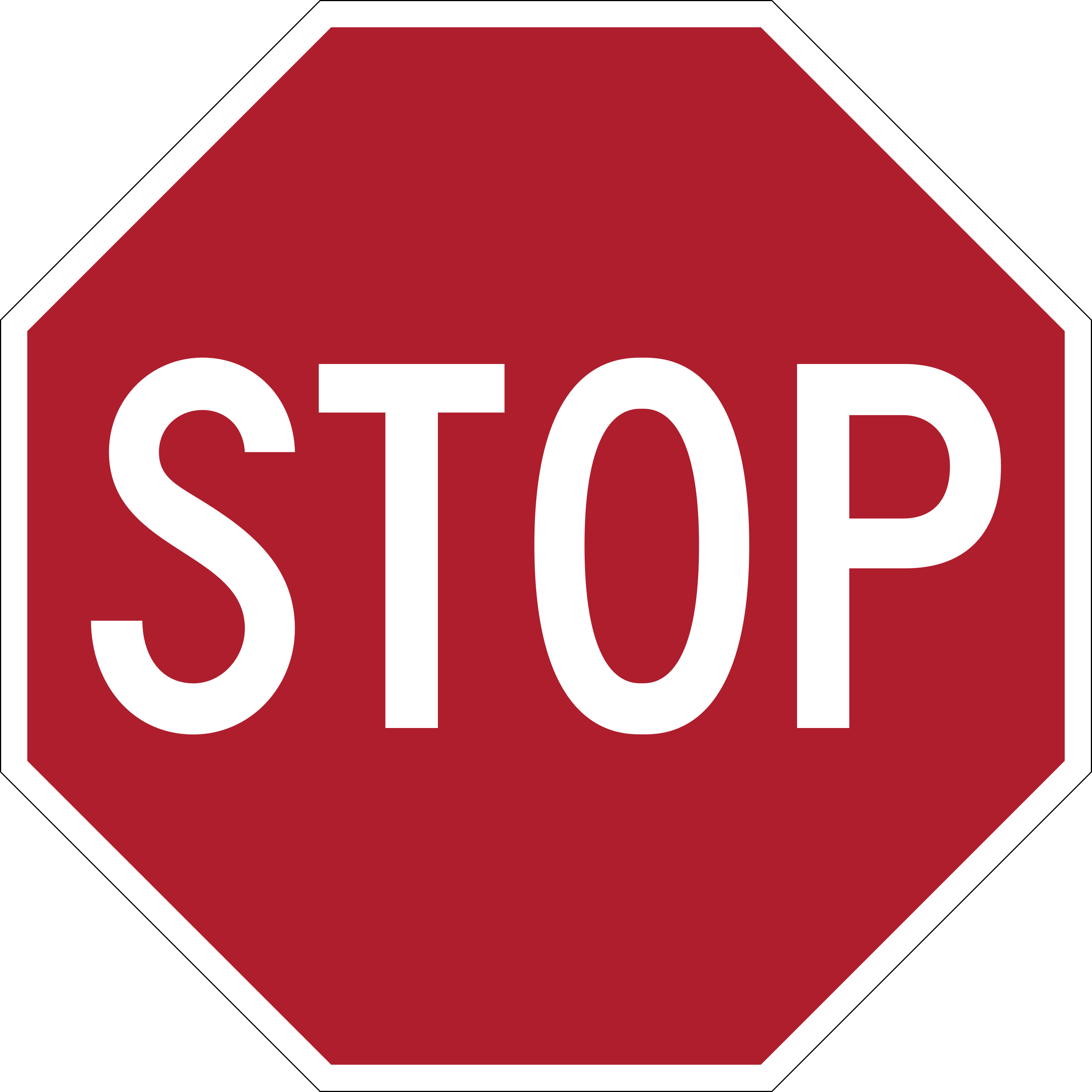
Question 1You come to a red, eight-sided sign. What does the Virginia manual say you must do?
Show the answer
Answer: C — Come to a complete stop at the sign, stop line, crosswalk or curb and wait for vehicles and pedestrians to clear the way.
The octagon always means stop. You must come to a complete stop at the sign, stop line, pedestrian crosswalk or curb and wait for any vehicle or pedestrian to clear the way.
Checked against: Virginia Driver's Manual (April 2026), Section 2 — Sign Shapes (Octagon)
-
Question 2On a Virginia road sign, what does yellow used with black convey?
Show the answer
Answer: A — A warning, such as a curve, a stop ahead or a slippery road.
The manual says yellow with black conveys a warning (curve ahead, stop ahead, overhead clearance, slippery when wet). Black and white signs are regulatory, blue signs show services and brown signs show historical or cultural interests.
Checked against: Virginia Driver's Manual (April 2026), Section 2 — Sign Colors
-
Question 3A yellow diamond-shaped sign shows a leaping deer. What should you do?

Show the answer
Answer: B — Slow down, be alert and be ready to stop.
The Deer Crossing sign means deer cross the roadway in this area. The manual tells you to slow down, be alert and be ready to stop.
Checked against: Virginia Driver's Manual (April 2026), Section 2 — Warning Signs (Deer Crossing)
-
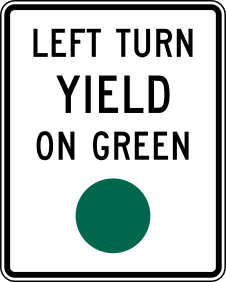
Question 4A sign next to a traffic signal reads LEFT TURN YIELD ON GREEN. What does it tell you?
Show the answer
Answer: D — Traffic turning left on a green light does not have the right-of-way and must yield to oncoming traffic.
The Left Turn Yield on Green sign is used with a traffic signal. Drivers turning left on a green light must yield to traffic coming from the other direction, then proceed with caution.
Checked against: Virginia Driver's Manual (April 2026), Section 2 — Regulatory Signs (Left Turn Yield on Green)
-
Question 5What does a five-sided (pentagon-shaped) sign mark?

Show the answer
Answer: B — A school zone or school crossing.
The pentagon marks school zones and warns you about school crossings. Two signs may be used together to show the actual location of the crosswalk.
Checked against: Virginia Driver's Manual (April 2026), Section 2 — Sign Shapes (Pentagon)
-
Question 6When may you turn right on a steady red light in Virginia?
Show the answer
Answer: D — After a complete stop, yielding to pedestrians and traffic, unless a NO TURN ON RED sign or a red right arrow is displayed.
Virginia allows a right turn on red after a complete stop, looking both ways and yielding to pedestrians and other traffic. You may not turn if a No Turn on Red sign is posted or a red arrow pointing right is displayed.
Checked against: Virginia Driver's Manual (April 2026), Section 2 — Traffic Signals (Right turn on red)
-
Question 7The traffic signals at an intersection are out of service and show no lights. No officer is directing traffic. What must you do?
Show the answer
Answer: B — Stop and proceed as though the intersection were an all-way stop.
When signals are not working and display no lights, you must stop and proceed through the intersection as though it were an all-way stop, unless an officer is directing traffic or portable stop signs are in use.
Checked against: Virginia Driver's Manual (April 2026), Section 2 — Traffic Signals (Out of service signals)
-
Question 8A broken yellow line runs alongside a solid yellow line in the center of the road. The broken line is on your side. What does this mean?
Show the answer
Answer: D — You may pass when the way ahead is clear; drivers on the solid-line side may not pass.
A broken yellow line alongside a solid yellow line means passing is allowed from the side of the broken line but not from the side of the solid line.
Checked against: Virginia Driver's Manual (April 2026), Section 2 — Pavement Markings
-
Question 9Unless a sign says otherwise, what is the maximum speed limit for passenger vehicles in school, business and residential areas in Virginia?
Show the answer
Answer: C — 25 MPH.
Unless posted otherwise, the maximum speed limit for passenger vehicles and motorcycles is 25 MPH in school, business and residential areas, 35 MPH on unpaved roads and 55 MPH on all other roads.
Checked against: Virginia Driver's Manual (April 2026), Section 3 — Speed Limits
-
Question 10A school bus is stopped on a two-lane road with red lights flashing and its stop sign extended. You are behind it, going the same way. What must you do?
Show the answer
Answer: A — Stop and remain stopped until all persons are clear and the bus moves again.
You must stop for a stopped school bus with flashing red lights and an extended stop sign when you approach from any direction, and remain stopped until all persons are clear and the bus moves again.
Checked against: Virginia Driver's Manual (April 2026), Section 3 — Stopping for School Buses
-
Question 11Two vehicles arrive at the same time at an intersection with no signs or signals. Which driver must let the other go first?
Show the answer
Answer: B — The driver on the left lets the driver on the right go first.
When vehicles from different directions arrive at the same time at an intersection with no signs or signals, the driver on the left must allow the driver on the right to go first.
Checked against: Virginia Driver's Manual (April 2026), Section 3 — Yielding the Right-of-Way
-
Question 12How far ahead of a turn should you signal, according to the Virginia manual?
Show the answer
Answer: A — At least three to four seconds, 100 feet, before the turn.
The manual says to signal at least three or four seconds, 100 feet, ahead of the turn.
Checked against: Virginia Driver's Manual (April 2026), Section 3 — Turning; Turn Signals
-
Question 13How does the traffic signs part of the Virginia knowledge exam work?
Show the answer
Answer: D — It has 10 road sign questions and you must answer all ten correctly before you can take part two.
Part one of the knowledge exam has 10 road sign questions, and all ten must be answered correctly. Part two has 30 general knowledge questions, of which you must answer 24 correctly.
Checked against: Virginia DMV — The Knowledge Exam (Passing the Knowledge Exam); manual Section 1
-
Question 14Picturing the steering wheel as a clock, where does the Virginia manual say your hands should be?
Show the answer
Answer: C — At 8 o'clock and 4 o'clock.
Sit straight but relaxed with your hands at the 8 o'clock and 4 o'clock positions, holding the wheel with your fingers and thumbs rather than gripping with your palms.
Checked against: Virginia Driver's Manual (April 2026), Section 3 — Hand Position
-
Question 15On a dry road you are driving at 55 MPH. Using the manual's following distance rule, how many seconds behind the vehicle ahead should you stay?
Show the answer
Answer: D — At least 4 seconds.
The manual's table: 2 seconds under 35 MPH, 3 seconds at 35-45 MPH and 4 seconds at 46-70 MPH. At 55 MPH you need 4 seconds, and more in bad conditions.
Checked against: Virginia Driver's Manual (April 2026), Section 3 — Following Distance
-
Question 16What is the best way to check your blind spot before changing lanes?
Show the answer
Answer: B — Quickly turn your head and glance over your shoulder.
The best way to see a car in your blind spot is by quickly turning your head and glancing over your shoulder before changing lanes or passing.
Checked against: Virginia Driver's Manual (April 2026), Section 3 — Blind Spots
-
Question 17How much clearance does Virginia law require when you pass a bicyclist?
Show the answer
Answer: A — At least three feet; if the lane is too narrow, change lanes to pass.
State law requires motorists to pass cyclists with at least three feet of clearance. If the lane is not wide enough for three feet, the motorist must change lanes to pass safely.
Checked against: Virginia Driver's Manual (April 2026), Section 3 — Sharing the Road (Bicycles); Passing
-
Question 18Which headlights should you use in heavy fog?
Show the answer
Answer: C — Low beams.
Fog reflects light back into your eyes. Use low-beam headlights in heavy fog and look for road edge markings to guide you.
Checked against: Virginia Driver's Manual (April 2026), Section 3 — Hazardous Conditions (Fog)
-
Question 19Under Virginia law, when may a driver hold a cell phone while driving?
Show the answer
Answer: B — Only in a driver emergency or when the vehicle is lawfully parked or stopped.
Virginia law prohibits drivers from holding cell phones or other wireless devices while driving except in a driver emergency or when the vehicle is lawfully parked or stopped. Adults may use a phone for navigation if they are not entering information or holding it; drivers under 18 may not use a phone at all while driving, hand-held or not, except in an emergency while lawfully parked or stopped.
Checked against: Virginia Driver's Manual (April 2026), Section 3 — Distracted Driving
-
Question 20At what blood alcohol content (BAC) is a driver age 21 or older considered to be driving under the influence in Virginia?
Show the answer
Answer: D — 0.08 percent or higher.
Drivers 21 or older are considered to be DUI with a BAC of .08 percent or higher, and can be convicted with a lower BAC if their driving is impaired.
Checked against: Virginia Driver's Manual (April 2026), Section 3 — Drunk and Drugged Driving
Official passing standard: Part one: all 10 road sign questions correct (you must pass it before part two). Part two: at least 24 of 30 general knowledge questions correct (80 percent).
Virginia DMV knowledge exam format
| Section | Questions | Time |
|---|---|---|
| Part one: traffic signs | 10 | — |
| Virginia DMV knowledge exam | Official rule |
|---|---|
| Number of questions | Two parts: 10 road sign questions, then 30 general knowledge questions (multiple choice, on a computer) source |
| Passing score | All 10 sign questions correct, then at least 24 of the 30 general knowledge questions correct source |
| Where you take it | At a DMV customer service center, or in a classroom at a participating high school (remote testing in schools); oral exams on request at every customer service center source |
| Minimum age | 15 years and 6 months to apply for a learner's permit source |
| Fee | $3 learner's permit fee plus the yearly cost of the driver's license ($4 per year on the DMV fee chart DMV 201, dated 08/10/2026) source |
| Vision screening | Unrestricted license: 20/40 or better in one or both eyes and 110 degrees or better horizontal vision, with or without glasses source |
| Retake wait | Under 18: wait a full 15 days (fail on January 1, retest January 17 at the earliest). 18 or older: one attempt per day source |
| After three failures | You must complete the classroom part of a Virginia-approved driver education program (completion dated after the third failure) before retesting source |
| Result validity | If you do not get your permit or license within 1 year of the knowledge exam, you must retest source |
| Languages | Offered in English, American Sign Language, Amharic, Arabic, Chinese/Mandarin (simplified and traditional), Dari, Farsi, French, German, Haitian Creole, Italian, Japanese, Korean, Kurdish, Mongolian, Nepali, Pashto, Punjabi, Russian, Spanish, Thai, Twi (Akan), Turkish, Urdu and Vietnamese source |
| Supervising driver | A licensed driver at least 21, or at least 18 if your legal guardian or sibling, seated beside you source |
| Permit passengers | A learner's permit holder may not carry more than one passenger under 18 (family members excepted) source |
| Before a license (under 18) | Complete state-approved driver education, hold the permit at least 9 months and have a parent certify 45 hours of driving, 15 after sunset source |
| Before a license (18 and older) | Until 12/31/2026: hold the permit 60 days or complete driver education. From 01/01/2027: ages 18-20 must hold it 90 days and complete driver education; 21+ keep the 60-day-or-driver-ed choice source |
| Handbook edition | Virginia Driver's Manual (DMV 39), PDF dated April 2026 source |
Checked on the official sources on September 30, 2026. Rules change: always confirm on the official site before test day.
What the Virginia knowledge exam is
In Virginia, the knowledge exam is the test you pass to get a learner's permit, the first step toward a driver's license. You take it together with a vision screening at your permit appointment. The Virginia DMV describes it as a two-part exam that tests traffic signs, motor vehicle laws and safe driving, and all questions come from the Virginia Driver's Manual. You can apply for a learner's permit once you are at least 15 years and 6 months old.
Format and scoring
| Virginia knowledge exam | |
|---|---|
| Part one | 10 road sign questions, all ten must be correct |
| Part two | 30 general knowledge questions, 24 correct to pass (80 percent) |
| Question type | Multiple choice, on a computer |
| Vision screening | 20/40 or better in one or both eyes and 110 degrees horizontal vision for an unrestricted license |
| Languages | English, American Sign Language and 24 other languages |
The sign part is the one that surprises people. There is no margin: the manual says you must answer all ten traffic sign questions correctly before you can take part two. One wrong sign answer and you do not get to the general knowledge questions. Part two is more forgiving: you can miss up to six of the 30 questions.
The manual also says an audio version is available and translators may not be used for tests offered in your language. Oral exams are available on request at every customer service center. The DMV does not publish a time limit. It is unlawful to get or give help, try to obtain the questions or answers, or use a cell phone during the exam.
Where you can take it (and the online question)
You take the exam on a computer at a DMV customer service center, by appointment or as a walk-in. Walk-ins must arrive by 4:30 p.m. Monday to Friday or 11:30 a.m. on Saturday to test that day.
Many high school students can also take it at school. Under DMV's remote testing program, participating schools give the knowledge test online in a proctored classroom. Students get their result immediately and, if they pass, a testing receipt to take to a DMV customer service center to finish the permit. The DMV pages we checked do not describe a version you can take alone at home. The in-person final exam of an online driver education course is a different test from the DMV knowledge exam.
Step by step: from permit to license
- Study the manual. Download the free Virginia Driver's Manual (the current PDF is dated April 2026) and try the DMV's online practice exams.
- Gather your documents. You need a completed application, one proof of identity, one proof of legal presence, two proofs of Virginia residency and your Social Security number if you have one. If you are under 18, a parent or legal guardian must sign your application.
- Pay the fee. The permit costs a $3 learner's permit fee plus the yearly cost of a driver's license. The DMV fee chart lists the driver's license at $4 per year.
- Pass the vision screening and the two-part knowledge exam. DMV then mails your learner's permit to the address on record.
- Practice with a supervisor. A licensed driver must sit beside you. They must be at least 21, or at least 18 if they are your legal guardian or sibling.
- Meet the holding period and driver education rules. If you are under 18, you must complete a state-approved driver education program, hold the permit at least nine months and have a parent certify 45 hours of driving, 15 of them after sunset. The driver education program includes 36 classroom sessions, seven driving sessions and seven observation sessions, and for applicants under 18 the road skills test is given as part of the driver education course.
For first-time applicants 18 and older, the rules change on January 1, 2027. Until then, you hold the permit 60 days or complete driver education. From that date, applicants aged 18 through 20 must hold the permit at least 90 days and complete driver education; applicants 21 and older keep the choice between 60 days and driver education.
If you fail
- Under 18: you must wait a full 15 days. The DMV's example: fail on January 1, and the earliest retest is January 17.
- 18 or older: you may test once per day.
- After three failures, at any age: you must complete the classroom portion of a Virginia-approved driver training school program, finished after the date of your third failure, before you can test again. The manual also describes an 8-hour DMV-approved course based on the manual for this purpose. If you are under 18, you must have completed driver education classroom first.
- Each retake means a new application with your identity and residency documents. If you pass but do not get your permit or license within 1 year, you must retest.
Rules for permit holders and teen drivers
- Passengers: a learner's permit holder may not carry more than one passenger under 18. Family members do not count.
- Curfew: drivers under 18 may not drive from midnight to 4 a.m., except for work, supervised school or civic activities, with a licensed parent or adult in the front seat, or in an emergency.
- Phones: drivers under 18 may not use a cell phone while driving, hand-held or not, except for an emergency with the vehicle lawfully parked or stopped. For all drivers, Virginia prohibits holding a phone while driving except in an emergency or when lawfully parked or stopped.
Virginia rules that come up often
These points are specific to Virginia and appear in the Driver's Manual:
- Default speed limits: 25 MPH in school, business and residential areas, 35 MPH on unpaved roads and 55 MPH on other roads.
- Reckless driving: 20 MPH or more over the limit, or over 85 MPH, can be charged as reckless driving.
- Red lights: right on red after a full stop unless a sign or a red arrow forbids it; left on red only from a one-way street onto another one-way street; no turns on a red arrow unless a sign allows it.
- Emergency vehicles: never follow closer than 500 feet when lights are flashing.
- Alcohol: a BAC of .08 is DUI at 21 and older; under 21, a BAC of .02 to under .08 is illegal consumption.
- Parking: at least 15 feet from a hydrant, 20 feet from an intersection and 50 feet from a railroad crossing.
How to prepare
Start with the signs, because you need a perfect score on them. Section 2 of the manual shows each sign with its meaning; learn the shapes and colors first, then every picture. Then read Sections 3 to 5 for the general knowledge part and write the numbers on one page: following distances (2, 3 and 4 seconds), parking distances, BAC levels and the teen rules. Finish with the DMV's own practice exams.
Our practice questions are original, written from the current manual and DMV pages, and each explanation names the section it comes from. They are for practice and do not replace the manual. The DMV decides what is on your test.
Frequently asked questions
Do I really have to get all 10 sign questions right?
Yes. Part one has 10 road sign questions and all ten must be answered correctly. The manual adds that you must pass part one before you can take part two, the 30 general knowledge questions, where you need 24 correct. Source
Can I take the Virginia knowledge exam online at home?
No home version is described by the DMV. You take it on a computer at a DMV customer service center, or in a proctored classroom at a participating high school through DMV's remote testing program; students who pass there get a testing receipt to finish at a customer service center. The final exam of an online driver education course is a different test from the DMV knowledge exam. Source
How soon can I retake the test if I fail?
If you are under 18 you must wait a full 15 days (fail on January 1, earliest retest January 17). If you are 18 or older you may test once per day. Each retake requires a new application with identity and residency documents. Source
What happens after three failures?
Regardless of age, you must complete the classroom portion of a Virginia-approved driver training school program, finished after the date of your third failure, and present the certificate at a customer service center before you can retest. The manual also describes an 8-hour DMV-approved course based on the manual for this purpose. Source
How old do I have to be for a learner's permit?
You must be at least 15 years and six months old. If you are under 18, a parent or legal guardian must sign your application. Source
How long must I hold my permit?
Under 18: at least nine months, plus a state-approved driver education program and 45 hours of practice (15 after sunset) certified by a parent. 21 or older: 60 days or driver education. Ages 18 to 20: 60 days or driver education until December 31, 2026; from January 1, 2027, 90 days and driver education. Source
Who can ride with me on a learner's permit?
A licensed driver seated beside you who is at least 21, or at least 18 if they are your legal guardian or sibling, and who is alert and able to help. You may not carry more than one passenger under 18, except family members. Source
Do I need the knowledge exam if I am licensed in another state?
The manual says you need the two-part knowledge exam if you do not hold a valid driver's license from another U.S. state, Canada, Germany, France or the Republic of Korea. Source
Other states and road signs
California permit practice test
California DMV
Texas permit practice test
Texas Department of Public Safety
Florida permit practice test
Florida Department of Highway Safety and Motor Vehicles (FLHSMV)
New York permit practice test
New York State DMV
Pennsylvania permit practice test
PennDOT Driver and Vehicle Services
Ohio permit practice test
Ohio Bureau of Motor Vehicles (BMV)
North Carolina permit practice test
North Carolina Division of Motor Vehicles (NCDMV)
Georgia permit practice test
Georgia Department of Driver Services (DDS)
New Jersey permit practice test
New Jersey Motor Vehicle Commission (NJ MVC)
Illinois permit practice test
Illinois Secretary of State, Driver Services
Tennessee permit practice test
Tennessee Department of Safety and Homeland Security, Driver Services
Michigan permit practice test
Michigan Department of State (Secretary of State)
Road signs practice test
Shapes, colors and meanings
Sources
- Virginia Driver's Manual (DMV 39), complete PDF, 40 pages, file dated April 2026 — Virginia Department of Motor Vehicles (checked September 30, 2026)
- The Knowledge Exam — Virginia Department of Motor Vehicles (checked September 30, 2026)
- Apply for a Learner's Permit — Virginia Department of Motor Vehicles (checked September 30, 2026)
- Teen Driving Restrictions — Virginia Department of Motor Vehicles (checked September 30, 2026)
- Driver Education — Virginia Department of Motor Vehicles (checked September 30, 2026)
- Revised Learner's Permit Holding Period and Driver Education Requirements – FAQs — Virginia Department of Motor Vehicles (checked September 30, 2026)
- DMV Fees (DMV 201, 08/10/2026) — Virginia Department of Motor Vehicles (checked September 30, 2026)
- Vision Requirements Overview — Virginia Department of Motor Vehicles (checked September 30, 2026)
- Remote Testing in Schools — Virginia Department of Motor Vehicles (checked September 30, 2026)
- Online Driver Training Schools — Virginia Department of Motor Vehicles (checked September 30, 2026)
passmock is an independent practice resource. It is not affiliated with, endorsed by or connected to the Virginia Department of Motor Vehicles. Our questions are original practice questions written from the official test description and study materials; they are not questions from the real test.