Free Pennsylvania Permit Test practice test (20 questions)
Click an answer to see instantly if it is right, with the explanation. No sign-up, no email.
-
Question 1You approach a red, eight-sided sign at an intersection. What must you do?
Show the answer
Answer: D — Stop completely, check for pedestrians and cross traffic, and go only when the intersection is clear.
The octagon is used only for the STOP sign. Pennsylvania requires a complete stop; slowing down without stopping (a rolling stop) is illegal.
Checked against: PA Driver's Manual (PUB 95), Chapter 2 — Regulatory Signs (STOP sign)
-
Question 2A five-sided (pentagon-shaped) sign ahead tells you that you are:
Show the answer
Answer: C — Approaching a school zone.
The pentagon is the only five-sided sign used on the roadway and marks a school zone. With a downward arrow it marks the school crosswalk itself.
Checked against: PA Driver's Manual (PUB 95), Chapter 2 — Warning Signs (School)
-
Question 3A traffic light at an intersection is completely dark because of a power failure. How should you treat the intersection?
Show the answer
Answer: B — As a four-way stop.
The manual says a non-functioning traffic signal should be treated as though it were a four-way STOP sign: every driver stops, then proceeds in turn.
Checked against: PA Driver's Manual (PUB 95), Chapter 2 — Signals (Non-Functioning Traffic Lights)
-
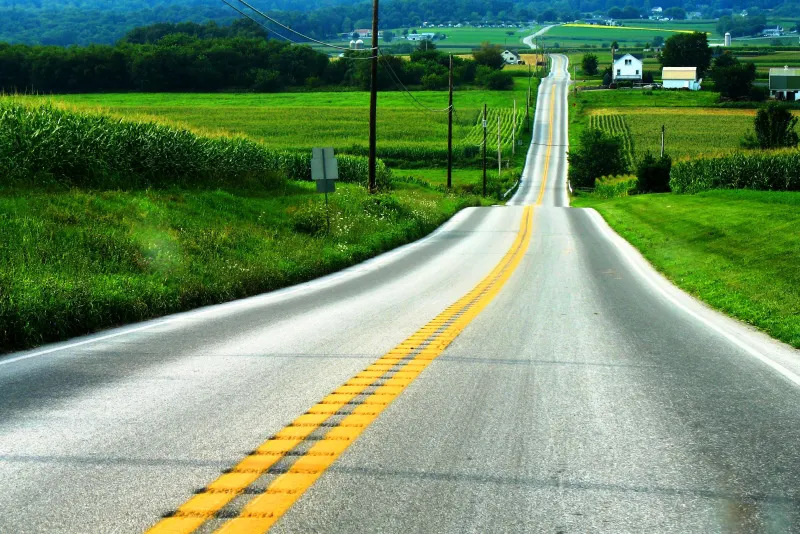
Question 4The center of a two-way road is marked with a double solid yellow line. Who may cross it to pass?
Show the answer
Answer: C — No one; passing is not allowed in either direction.
A double solid yellow centerline means passing is not allowed for traffic in either direction, even where there is no NO PASSING sign.
Checked against: PA Driver's Manual (PUB 95), Chapter 2 — Pavement Markings
-
Question 5How many questions are on the Pennsylvania non-commercial knowledge test, and how many must you answer correctly?
Show the answer
Answer: B — 18 questions; 15 correct to pass.
PennDOT's knowledge test has 18 multiple-choice questions and you must answer 15 correctly. It covers traffic signs, Pennsylvania driving laws and safe driving practices.
Checked against: PA Driver's Manual (PUB 95), Chapter 1 — Tests (Knowledge Test)
-
Question 6Before a driver under 18 can take the road test, the learner must complete how much supervised skill-building?
Show the answer
Answer: A — At least 65 hours, including at least 10 hours at night and 5 hours in bad weather.
Drivers under 18 need at least 65 hours of behind-the-wheel practice, with no less than 10 hours of nighttime and 5 hours of bad-weather driving, certified on form DL-180C.
Checked against: PA Driver's Manual (PUB 95), Chapter 1 — Applying for a Learner's Permit
-
Question 7A junior driver's license holder may NOT drive during which hours unless a parent, guardian or other qualifying adult is in the car (or a work or volunteer exception applies)?
Show the answer
Answer: D — 11 p.m. to 5 a.m..
Junior drivers may not drive between 11 p.m. and 5 a.m. unless a parent, guardian, person in loco parentis or spouse 18 or older is with them, or they carry a notarized work or volunteer affidavit.
Checked against: PA Driver's Manual (PUB 95), Chapter 1 — Junior Driver's License Information
-
Question 8A school bus is stopped with its red lights flashing and stop arm out. You are behind it on the same road. How close may you stop?
Show the answer
Answer: D — No closer than 10 feet.
Pennsylvania requires you to stop at least 10 feet from the bus, whether behind it, coming toward it, or at an intersection where it is stopped, until the lights stop and the arm is withdrawn.
Checked against: PA Driver's Manual (PUB 95), Chapter 3 — Special Circumstances and Emergencies (School Buses)
-
Question 9You approach an emergency response area on a multi-lane highway. Under Pennsylvania's Move Over law you must:
Show the answer
Answer: C — Move into a lane that is not next to the area, or if you cannot, slow to at least 20 mph below the posted limit.
The Move Over law requires moving to a non-adjacent lane. If traffic or conditions prevent it, you must reduce speed to at least 20 mph below the posted speed limit.
Checked against: PA Driver's Manual (PUB 95), Chapter 3 — Move Over Law
-
Question 10For a driver 21 or older, Pennsylvania considers you to be driving under the influence at what blood alcohol concentration (BAC)?
Show the answer
Answer: B — .08 or higher.
At 21 or older, a BAC of .08 or higher is DUI. You can also be convicted at a lower BAC if you are driving erratically.
Checked against: PA Driver's Manual (PUB 95), Chapter 4 — Driving Under the Influence (What Constitutes a DUI?)
-
Question 11Two cars reach a four-way stop at the same time from different streets. Which driver must yield?
Show the answer
Answer: B — The driver on the left yields to the driver on the right.
At a four-way stop the first vehicle to arrive goes first. If two arrive together, the driver on the left yields to the driver on the right.
Checked against: PA Driver's Manual (PUB 95), Chapter 3 — Negotiating Intersections
-
Question 12What is the earliest you can apply for a Pennsylvania non-commercial learner's permit?
Show the answer
Answer: C — On or after your 16th birthday.
You cannot apply for your permit before your 16th birthday. Only the physical exam on form DL-180 may be done up to six months earlier.
Checked against: PA Driver's Manual (PUB 95), Chapter 1 — Applying for a Learner's Permit
-
Question 13On dry pavement, what following distance does the Pennsylvania manual recommend?
Show the answer
Answer: A — At least 4 seconds.
A 4-second following distance lets you steer or brake to avoid a hazard on dry pavement. If you reach the same roadside marker in less than four seconds, you are too close.
Checked against: PA Driver's Manual (PUB 95), Chapter 3 — Managing Space (Keep a Space Cushion Ahead)
-
Question 14An oncoming driver does not dim their high beams. What should you do?
Show the answer
Answer: C — Look toward the right side of the road until the vehicle passes.
Flash your high beams briefly; if they still do not dim, look toward the right side of the road. Do not keep your bright lights on to punish the other driver.
Checked against: PA Driver's Manual (PUB 95), Chapter 3 — Managing Speed (Driving at Night)
-
Question 15Your vehicle starts to skid on an icy road and the rear slides to the left. What should you do?
Show the answer
Answer: A — Stay off the brakes and steer to the left, in the direction the rear is skidding.
Look and steer where you want to go: if the rear skids left, turn the wheel left. Do not brake, because braking makes the skid worse and can lock the wheels.
Checked against: PA Driver's Manual (PUB 95), Chapter 3 — Dealing with Driving Emergencies (If Your Vehicle Starts to Skid)
-
Question 16When are roads often most slippery during a rainstorm?
Show the answer
Answer: D — In the first 10 to 15 minutes, when oil rises to the surface.
Pavement can become very slippery in the first 10 to 15 minutes of rain because oil in the asphalt comes to the surface, especially in hot weather.
Checked against: PA Driver's Manual (PUB 95), Chapter 3 — Managing Speed (Road Conditions)
-
Question 17Which of these will lower your blood alcohol concentration?
Show the answer
Answer: A — Only time.
Only time sobers you up. Coffee, caffeinated drinks or a cold shower do not reduce BAC. It takes an average person at least one hour to process each drink.
Checked against: PA Driver's Manual (PUB 95), Chapter 3 — Driver Factors (Alcohol and Driving)
-
Question 18You are following a large truck and cannot see its side mirrors. What does this mean?
Show the answer
Answer: D — The truck driver cannot see you.
If you cannot see the side mirrors of a truck or bus ahead, its driver cannot see you. Drop back out of the No-Zone so the driver can see you in the mirrors.
Checked against: PA Driver's Manual (PUB 95), Chapter 3 — Sharing the Road with Trucks and Buses (Following a Truck)
-
Question 19You must drive in fog. Which headlights should you use?
Show the answer
Answer: A — Low beams (and fog lights if you have them).
In fog use low beams, day or night. High beams shine into the fog and reflect back as glare. Slow down so you can stop within the distance you can see.
Checked against: PA Driver's Manual (PUB 95), Chapter 3 — Managing Speed (Visibility Conditions)
-
Question 20A tire blows out while you are driving. What should you do first?
Show the answer
Answer: B — Hold the steering wheel tightly and stay off the brake while easing off the gas.
Hold the wheel tightly, stay off the brake (braking can cause a skid), slowly take your foot off the gas and steer smoothly to a safe place.
Checked against: PA Driver's Manual (PUB 95), Chapter 3 — Dealing with Driving Emergencies (If You Have a Tire Blowout)
Official passing standard: 15 correct answers out of 18
Want more? The Pennsylvania Permit Test Practice Pack has more practice tests in the same format, with every answer explained.
Pennsylvania Permit Test format
| Pennsylvania Permit Test | Official rule |
|---|---|
| Number of questions | 18 multiple-choice questions source |
| Passing score | 15 correct answers (out of 18) source |
| Topics | Traffic signs, Pennsylvania driving laws and safe driving practices source |
| Where you take it | At a PennDOT Driver License Center. A remote pilot launched in November 2025 lets students at two Tioga County high schools (Williamson and Cowanesque Valley) take it at school; PennDOT does not list a general at-home online test. source |
| Languages and formats | Written and audio versions, on request, in Albanian, Amharic, Arabic, Bosnian, Burmese, Cambodian, Dari, English, Farsi, French, Greek, Hindi, Italian, Japanese, Korean, Mandarin, Mandinka, Nepali, Pashto, Polish, Portuguese, Punjabi, Russian, Somali, Spanish, Swahili, Turkish, Ukrainian, Urdu and Vietnamese source |
| Minimum age | 16; you cannot apply for a learner's permit before your 16th birthday source |
| Physical exam (form DL-180) | Your health care provider completes the back of the DL-180 no earlier than six months before your 16th birthday; the application is valid for one year from the exam date source |
| Parent consent | Under 18: parent, guardian, person in loco parentis or spouse 18 or older signs the DL-180TD (notarized if they cannot come with you) source |
| Fee | $45.50 for the initial permit and 4-year license ($33.50 for the 2-year license at age 65+), fee chart dated July 2025 source |
| Permit validity | One year from the issue date source |
| Supervised practice (under 18) | At least 65 hours, including 10 hours at night and 5 hours in bad weather, certified on form DL-180C source |
| Holding period (under 18) | Six months from the permit issue date before the road test source |
| Knowledge test retake | The following business day; only one attempt per day at any location source |
| Road test retake | Under 18: wait 7 days after a failure; 3 attempts per learner's permit source |
| Official handbook | Pennsylvania Driver's Manual, PUB 95 (4-21), free online, in PDF, audio and 30+ languages. It was last revised in April 2021, so later changes such as the 2025 hands-free law are only on PennDOT's web pages source |
Checked on the official sources on September 30, 2026. Rules change: always confirm on the official site before test day.
What the Pennsylvania permit test is
To drive in Pennsylvania you first need a learner's permit, and to get one you must pass PennDOT's knowledge test. It checks what you know about traffic signs, Pennsylvania driving laws and safe driving practices. Everything on it is covered in the free Pennsylvania Driver's Manual (PUB 95), the official study guide.
Format and passing score
| Questions | 18 multiple-choice |
| To pass | 15 correct answers |
| Topics | Signs, Pennsylvania laws, safe driving practices |
| Where | A PennDOT Driver License Center |
| Retake | The following business day |
With 18 questions and a pass mark of 15, you can miss no more than three. PennDOT does not publish a time limit or how many questions come from each topic.
The test is available in written and audio form, on request, in 30 languages, including Spanish, Arabic, Mandarin, Hindi, Nepali, Russian, Ukrainian and Vietnamese. Deaf and hard-of-hearing applicants can ask for a sign language interpreter; the manual asks you to contact PennDOT at least two weeks before your test date.
Can I take it online? PennDOT does not list an at-home knowledge test. In November 2025 it started a remote testing pilot that lets students at two Tioga County high schools test at school. Everyone else tests at a Driver License Center.
Step by step: getting your learner's permit
- Check your age. You cannot apply before your 16th birthday.
- Fill in the application. Complete the Non-Commercial Learner's Permit Application (DL-180).
- Get the physical exam. Your health care provider completes the back of the DL-180 no earlier than six months before your 16th birthday. The application is valid for one year from the exam date. If the examiner cannot tell whether you meet the medical standards, your permit may be delayed.
- Parent consent if you are under 18. A parent, guardian, person in loco parentis or spouse aged 18 or older signs the Parent or Guardian Consent Form (DL-180TD). If that person cannot come with you, the form must be signed in front of a notary. Applicants over 18 bring two proofs of residency instead, such as a utility bill, W-2 or lease.
- Go to a Driver License Center with the DL-180 (do not mail it), the DL-180TD if you are under 18, original proof of date of birth and identity (no photocopies), your Social Security card and the fee. A standard U.S. passport and a passport card are both accepted as identity documents.
- Take the vision and knowledge tests. If your eye doctor or health care provider did not test your vision, it is tested at the center, so bring your glasses or contacts.
- Get your permit. When you pass, the examiner gives you a learner's permit valid for one year.
Fees
PennDOT's fee chart (July 2025) lists $45.50 for the initial permit and 4-year license, or $33.50 with a 2-year license if you are 65 or older. Accepted forms of payment are listed on the back of the DL-180. You can also choose to add a $3 donation to the Organ Donation Awareness Trust Fund or a donation to the Veterans' Trust Fund.
If you fail
You can retake the knowledge test the following business day, but only once on any day, at any location. The examiner gives your DL-180 and DL-180TD back, so keep them safe and bring them again.
After the permit: rules for drivers under 18
- Supervision: you may drive only with a licensed driver who is at least 21, or a licensed parent, guardian or spouse aged 18 or older, sitting in the front seat.
- Passengers: no more passengers than there are seat belts.
- Practice: at least 65 hours of supervised driving, including 10 at night and 5 in bad weather, certified on form DL-180C.
- Holding period: you must wait six months from the permit issue date before the road test. PennDOT lets young drivers book the road test up to six months ahead, as long as the date is not before the eligibility date on the permit.
- Road test retakes: if you fail, you wait seven days, and you get three attempts per permit.
Once you pass the road test you receive a junior driver's license. According to the manual, junior drivers may not drive between 11 p.m. and 5 a.m. without a parent or guardian (with exceptions for work and volunteer service). For the first six months they may carry no more than one non-family passenger under 18 without a parent in the car, then three. Six points, or a conviction for driving 26 mph or more over the limit, brings a 90-day suspension. The junior license becomes a regular license at 18, or earlier after one year with no at-fault crash and no conviction, an approved driver training course and a parent's or guardian's consent.
What to study
The test follows the manual's chapters, so read these closely:
- Chapter 1 (permits and junior licenses): the age, hours, passenger and curfew rules above.
- Chapter 2 (signals, signs and pavement markings): sign shapes and colors (the octagon is STOP, the pentagon is a school zone, the pennant marks a no-passing zone), flashing yellow arrows, lane-use signals and centerline markings.
- Chapter 3 (learning to drive): the 4-second following distance, the 15 mph school zone limit, stopping at least 10 feet from a school bus with red lights flashing, the Move Over law, work zones, parking distances and emergencies.
- Chapter 4 (driving record): the point system, DUI limits (.08 at 21 and over, .02 under 21) and the Implied Consent law.
- Chapter 5 (laws): seat belts, child restraints, the 4-foot rule for passing bicycles.
The manual was last revised in April 2021, so check PennDOT's web pages for anything newer. For example, Pennsylvania's hands-free law (Paul Miller's Law) has banned handheld phone use while driving since June 5, 2025. That includes being stopped at a light, and since June 5, 2026 it carries a $50 fine.
How to prepare
Read the manual once from start to finish, then go back over the numbers: distances, ages, hours, BAC limits and suspension lengths are easy to mix up. PennDOT also offers a free sample knowledge test. Our practice tests use original questions written from the manual, 18 at a time, with the same 15-correct pass mark. Each answer has an explanation and a reference to the manual section, so you can look up anything you get wrong.
Frequently asked questions
How many questions are on the Pennsylvania permit test and what score do I need?
The knowledge test has 18 multiple-choice questions, and you must answer 15 correctly to pass. Source
What happens if I fail the knowledge test?
You may retake it the following business day. You can take it only once on any day, whatever the location, and the examiner gives your DL-180 and DL-180TD back to you, so keep them and bring them next time. Source
What do I need to bring to the Driver License Center?
Your completed DL-180 (with the health care provider section filled in), the DL-180TD consent form if you are under 18, original proof of date of birth and identity, your Social Security card, and the fee. Photocopies are not accepted. Source
Can I take the test in another language or have it read to me?
Yes. PennDOT offers the knowledge test in written and audio format on request at all Driver License Centers, in Albanian, Amharic, Arabic, Bosnian, Burmese, Cambodian, Dari, English, Farsi, French, Greek, Hindi, Italian, Japanese, Korean, Mandarin, Mandinka, Nepali, Pashto, Polish, Portuguese, Punjabi, Russian, Somali, Spanish, Swahili, Turkish, Ukrainian, Urdu and Vietnamese. Source
Can I take the Pennsylvania permit test online from home?
PennDOT does not list an at-home online knowledge test. In November 2025 it launched a remote-testing pilot that lets students at Williamson and Cowanesque Valley high schools in Tioga County take the test at school; everyone else tests at a Driver License Center. Source
When can a teen take the road test?
Drivers under 18 must hold the permit for six months and have a signed certificate for 65 hours of practice, including 10 at night and 5 in bad weather. The road test can be scheduled up to six months in advance, but not before the eligibility date on the permit. Source
What limits apply to a junior driver's license?
No driving from 11 p.m. to 5 a.m. without a parent or guardian (with work and volunteer exceptions), no more passengers than seat belts, and no more than one non-family passenger under 18 without a parent for the first six months (three after that, if you have no at-fault crash or conviction). Source
Sources
- Pennsylvania Driver's Manual, PUB 95 (4-21), English — PennDOT Bureau of Driver Licensing (checked September 30, 2026)
- Online Driver's Manual, Chapter 1: Testing — PennDOT Driver and Vehicle Services (checked September 30, 2026)
- Get a Learner's Permit — Commonwealth of Pennsylvania (checked September 30, 2026)
- Online Driver's Manual, Chapter 1: Applying for a Learner's Permit — PennDOT Driver and Vehicle Services (checked September 30, 2026)
- Driver Licensing Fee Chart Fact Sheet (July 2025) — PennDOT (checked September 30, 2026)
- Distracted Driving Fact Sheet (Paul Miller's Law) — PennDOT (checked September 30, 2026)
- Remote Learner's Permit Knowledge Testing Pilot — PennDOT (checked September 30, 2026)
PennDOT and the Pennsylvania Department of Transportation are not affiliated with and do not endorse passmock. Our practice questions are original and written from the official Pennsylvania Driver's Manual. Our questions are original practice questions written from the official test description and study materials; they are not questions from the real test.