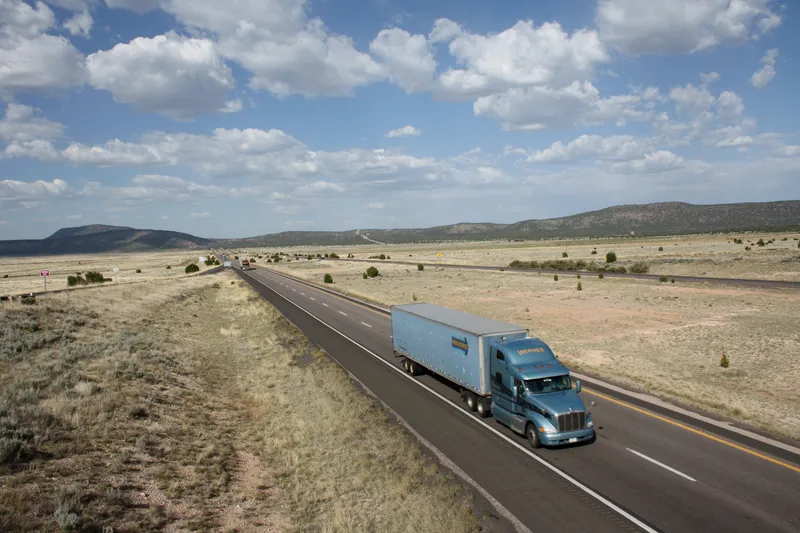
What this section covers: Parts of an air brake system (compressor, governor, tanks, valves, gauges), Spring brakes and parking brake controls, Dual air brake systems, Inspecting air brake systems, Using air brakes: normal and emergency stops, brake lag and stopping distance, Low air pressure, brake fade and downgrade braking, Anti-lock braking systems.
15 free practice questions
Click an answer: you see at once whether it is right, with the explanation.
-
Question 1Air brakes on a commercial vehicle are really three braking systems. Which three?
Show the answer
Answer: A — Service brake, parking brake and emergency brake.
The manual describes air brakes as three systems: the service brake (pedal, normal driving), the parking brake (parking control) and the emergency brake, which uses parts of the other two to stop the vehicle if the brake system fails.
Checked against: California Commercial Driver Handbook, Section 5 Air Brakes, 5 Air Brakes, introduction; same in NY CDL-10 (11/25) 5 introduction
-
Question 2A driver never drains the air tanks of a truck that has only manual drain valves. What problem does the manual warn this can cause in cold weather?
Show the answer
Answer: A — Water that collects in the tanks can freeze and cause brake failure.
Compressed air carries water and compressor oil, which collect at the bottom of the tanks. The water can freeze in cold weather and cause brake failure, which is why the tanks must be drained completely.
Checked against: California Commercial Driver Handbook, Section 5 Air Brakes, 5.1.4 Air Tank Drains; same in NY CDL-10 (11/25) 5.1.4
-
Question 3The safety relief valve on an air brake system is usually set to open at what pressure?
Show the answer
Answer: C — 150 psi.
The safety valve, in the first tank the compressor fills, is usually set to open at 150 psi to protect the system from too much pressure. 125 psi is the usual governor cut-out; if the safety valve ever releases air, something is wrong and a mechanic should fix it.
Checked against: California Commercial Driver Handbook, Section 5 Air Brakes, 5.1.6 Safety Valve; same in NY CDL-10 (11/25) 5.1.6
-
Question 4What is the most common type of foundation brake on air-braked vehicles?
Show the answer
Answer: A — The S-cam drum brake.
Foundation brakes are the brakes at each wheel, and the most common type is the S-cam drum brake. Wedge brakes and air disc brakes exist but are less common.
Checked against: California Commercial Driver Handbook, Section 5 Air Brakes, 5.1.8 Foundation Brakes; same in NY CDL-10 (11/25) 5.1.8
-
Question 5On a long downgrade you notice you must use more and more application pressure to hold the same speed. What does this mean, and what should you do?
Show the answer
Answer: C — The brakes are fading; slow down and use a lower gear.
The application pressure gauge shows how much air you are applying. Needing more pressure to hold the same speed means the brakes are fading, so slow down and use a lower gear. Brakes out of adjustment, air leaks or mechanical problems can also cause it.
Checked against: California Commercial Driver Handbook, Section 5 Air Brakes, 5.1.10 Application Pressure Gauge; same in NY CDL-10 (11/25) 5.1.10
-
Question 6An older truck has a front brake limiting valve control marked "normal" and "slippery." Where should the control be set?
Show the answer
Answer: C — In the "normal" position, to keep normal stopping power.
The slippery position cuts normal air pressure to the front brakes by half, which reduces the vehicle's stopping power. Front wheel braking is good under all conditions, and tests show front wheel skids from braking are not likely even on ice.
Checked against: California Commercial Driver Handbook, Section 5 Air Brakes, 5.1.13 Front Brake Limiting Valve; same in NY CDL-10 (11/25) 5.1.13
-
Question 7On newer vehicles with air brakes, how do you put on the parking brakes?
Show the answer
Answer: D — Pull out the yellow, diamond-shaped push-pull knob.
Newer vehicles use a yellow, diamond-shaped push-pull knob: pull it out to apply the parking (spring) brakes and push it in to release them.
Checked against: California Commercial Driver Handbook, Section 5 Air Brakes, 5.1.15 Parking Brake Controls; same in NY CDL-10 (11/25) 5.1.15
-
Question 8Truck tractors with air brakes built on or after which date are required to have anti-lock brakes?
Show the answer
Answer: A — March 1, 1997.
Truck tractors with air brakes built on or after March 1, 1997 must have ABS. Other air-braked vehicles (trucks, buses, trailers and converter dollies) are covered from March 1, 1998.
Checked against: California Commercial Driver Handbook, Section 5 Air Brakes, 5.1.16 Anti-lock Braking Systems; same in NY CDL-10 (11/25) 5.1.16 Antilock Braking Systems
-
Question 9Before driving a vehicle with a dual air brake system, how much pressure should the compressor build up?
Show the answer
Answer: B — At least 100 psi in both the primary and secondary systems.
Allow time for the compressor to build a minimum of 100 psi in both the primary and the secondary systems, and watch both gauges (or both needles). The safety valve opening means something is wrong, not that you are ready.
Checked against: California Commercial Driver Handbook, Section 5 Air Brakes, 5.2 Dual Air Brake; same in NY CDL-10 (11/25) 5.2
-
Question 10When you check slack adjusters on S-cam brakes, how much movement where the push rod attaches suggests the slack adjuster probably needs adjustment?
Show the answer
Answer: D — More than about one inch.
Park on level ground, chock the wheels, release the parking brakes and pull hard on each slack adjuster you can reach (wearing gloves). If it moves more than about one inch where the push rod attaches, it probably needs adjustment.
Checked against: California Commercial Driver Handbook, Section 5 Air Brakes, 5.3.2 During Step 5 Walk Around Inspection; same in NY CDL-10 (11/25) 5.3.2
-
Question 11In a dual air brake system, how fast should air pressure build from about 85 to 100 psi?
Show the answer
Answer: B — Within 45 seconds.
In dual air systems, pressure should build from about 85 to 100 psi within 45 seconds. The 3-minute figure applies to older single air systems (pre-1975), which should build from about 50 to 90 psi.
Checked against: California Commercial Driver Handbook, Section 5 Air Brakes, 5.3.3 Step 7, Check the Rate of Air Pressure Buildup; same in NY CDL-10 (11/25) 5.3.3 Check Rate of Air Pressure Buildup
-
Question 12Which describes the "stab braking" method for an emergency stop?
Show the answer
Answer: B — Apply the brakes all the way, release when the wheels lock, and reapply fully as soon as the wheels start rolling.
Stab braking means full application, release when the wheels lock up, then full application again once the wheels roll. Braking as hard as possible without locking the wheels, with very small steering movements, is the other method, controlled braking.
Checked against: California Commercial Driver Handbook, Section 5 Air Brakes, 5.4.3 Emergency Stops; same in NY CDL-10 (11/25) 5.4.3
-
Question 13What is "brake lag" on a vehicle with air brakes?
Show the answer
Answer: A — The time it takes for the brakes to work after the brake pedal is pushed, because air must flow through the lines.
With air brakes it takes a little time, one half second or more, for air to flow through the lines to the brakes. Hydraulic brakes work instantly. Brake lag adds a fourth part to total stopping distance.
Checked against: California Commercial Driver Handbook, Section 5 Air Brakes, 5.4.4 Stopping Distance; same in NY CDL-10 (11/25) 5.4.4
-
Question 14The low air pressure warning comes on while you are driving. What should you do?
Show the answer
Answer: A — Stop and safely park the vehicle as soon as possible.
There may be an air leak, and controlled braking is possible only while enough air remains in the tanks. The spring brakes come on at 20 to 45 psi, and a sudden spring brake stop can be long or cause a skid, so stop while you can still use the foot brake.
Checked against: California Commercial Driver Handbook, Section 5 Air Brakes, 5.4.7 Low Air Pressure; same in NY CDL-10 (11/25) 5.4.7
-
Question 15After coming down a long, steep grade, your brakes are very hot. How should you hold the vehicle when you park?
Show the answer
Answer: B — Use wheel chocks and let the brakes cool before using the parking brakes.
Parking brakes used while the brakes are very hot can be damaged by the heat. Use wheel chocks to hold the vehicle and let hot brakes cool before setting the parking brakes.
Checked against: California Commercial Driver Handbook, Section 5 Air Brakes, 5.4.8 Parking Brakes; same in NY CDL-10 (11/25) 5.4.8
More CDL Knowledge Tests practice
Full free CDL Knowledge Tests practice test
Mixed questions, test format and official rules.
CDL General Knowledge practice test
15 free questions
CDL Combination Vehicles practice test
15 free questions
passmock is an independent practice service. It is not affiliated with or endorsed by the Federal Motor Carrier Safety Administration (FMCSA), the U.S. Department of Transportation, the American Association of Motor Vehicle Administrators (AAMVA) or any state DMV, DPS or driver licensing agency. Our questions are original practice questions written from the official state CDL manuals and federal regulations; they are not taken from any state's test. Original practice questions, not questions from the real test.
Short on time? A professional can help
Prefer to work with a professional? A tutor, a prep course or a driving school: we can pass your request to up to 3 partners. Free, no obligation; passmock does not teach. How to choose.