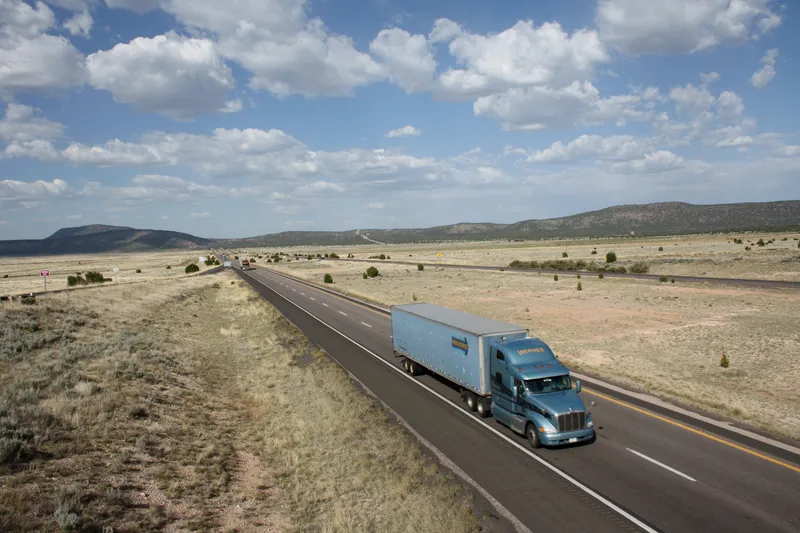
What this section covers: Driving combination vehicles safely (rollover, rearward amplification, off-tracking, backing), Combination vehicle air brakes (trailer air supply, glad hands, tractor protection valve, hand valve), Trailer anti-lock brakes, Coupling and uncoupling, Inspecting a combination vehicle.
15 free practice questions
Click an answer: you see at once whether it is right, with the explanation.
-
Question 1What causes the "crack-the-whip" effect when a truck pulling trailers makes a quick lane change?
Show the answer
Answer: D — Rearward amplification.
Rearward amplification makes a sudden steering movement grow larger toward the back of the rig, which can turn the trailer over. Off-tracking is about the path rear wheels follow in a turn, not about tipping in a lane change.
Checked against: California Commercial Driver Handbook, Section 6.1.2 Steer Gently; same text in NY CDL-10 Section 6.1.2
-
Question 2In the handbook's chart, a rearward amplification of 2.0 means that:
Show the answer
Answer: A — The rear trailer is twice as likely to turn over as the tractor.
Rearward amplification measures how much more easily the rear unit turns over in a quick lane change. A value of 2.0 means the rear trailer is twice as likely to turn over as the tractor; it says nothing about stopping distance or off-tracking.
Checked against: California Commercial Driver Handbook, Section 6.1.2 Steer Gently; same text in NY CDL-10 Section 6.1.2
-
Question 3Compared with the same combination vehicle fully loaded, an empty combination vehicle generally:
Show the answer
Answer: C — Takes longer to stop.
Large combination vehicles take longer to stop when empty than when fully loaded. Stiff suspension springs and strong brakes give poor traction when lightly loaded, so the wheels lock up very easily.
Checked against: California Commercial Driver Handbook, Section 6.1.3 Brake Early; same text in NY CDL-10 Section 6.1.3
-
Question 4You brake hard and see in your mirror that the trailer wheels have locked and the trailer is starting to swing out. What should you do?
Show the answer
Answer: D — Release the brakes so the trailer wheels can regain traction.
Releasing the brakes lets the trailer wheels grip the road again, and the trailer then starts to follow the tractor and straighten out. The trailer hand valve is the wrong tool because braking the trailer wheels caused the skid.
Checked against: California Commercial Driver Handbook, Section 6.1.5 Prevent Trailer Skids; same text in NY CDL-10 Section 6.1.5
-
Question 5Your route crosses a steep, humped railroad-highway crossing. Which of these rigs is the most likely to bottom out and get stuck on it?
Show the answer
Answer: C — A car carrier with little clearance underneath.
Low-slung units such as lowboys, car carriers, moving vans and possum-belly livestock trailers can hang up on raised crossings. Rigs with normal or high ground clearance are much less likely to get stuck.
Checked against: California Commercial Driver Handbook, Section 6.1.4 Railroad-Highway Crossings; same text in NY CDL-10 Section 6.1.4
-
Question 6You are backing a tractor-semitrailer. To start the trailer moving toward one side, how do you turn the steering wheel?
Show the answer
Answer: D — In the opposite direction from the way you want the trailer to go.
When backing a car, straight truck or bus you turn the top of the wheel the way you want to go, but with a trailer you turn it the opposite way. Once the trailer starts to turn, you turn the wheel the other way to follow it.
Checked against: California Commercial Driver Handbook, Section 6.1.7 Backing With a Trailer; same text in NY CDL-10 Section 6.1.7
-
Question 7There is no room to back the trailer straight into a dock, so you must back along a curve. Which way should the curve go?
Show the answer
Answer: A — Toward the driver's side, so you can see the trailer's path.
Backing in a straight line is best. When a curve cannot be avoided, back toward the driver's side so you can see where the trailer is going.
Checked against: California Commercial Driver Handbook, Section 6.1.7 Backing With a Trailer; same text in NY CDL-10 Section 6.1.7
-
Question 8When should the trailer hand valve (trolley valve) be used?
Show the answer
Answer: C — Only to test the trailer brakes.
The hand valve should be used only to test the trailer brakes. Using it while driving can make the trailer skid, and it must never be used for parking because the air can leak out and release the brakes.
Checked against: California Commercial Driver Handbook, Section 6.2.1 Trailer Hand Valve; same text in NY CDL-10 Section 6.2.1
-
Question 9On newer vehicles, what does the trailer air supply control look like?
Show the answer
Answer: C — A red eight-sided knob.
The trailer air supply control is a red eight-sided knob: push it in to supply air to the trailer, pull it out to shut the air off and set the trailer emergency brakes. Older vehicles may use a lever instead.
Checked against: California Commercial Driver Handbook, Section 6.2.3 Trailer Air Supply Control; same text in NY CDL-10 Section 6.2.3
-
Question 10You press the brake pedal lightly, then harder. Which trailer air line changes its pressure to match how hard you are pressing?
Show the answer
Answer: D — The service (control) line.
The service line, also called the control or signal line, carries air whose pressure rises and falls with how hard you press the foot brake or hand valve. The emergency (supply) line fills the trailer tanks and controls the emergency brakes.
Checked against: California Commercial Driver Handbook, Section 6.2.4 Trailer Air Lines; same text in NY CDL-10 Section 6.2.4
-
Question 11You crossed the air lines while coupling a trailer that has spring brakes. What happens when you push in the trailer air supply control?
Show the answer
Answer: D — The trailer spring brakes do not release, because supply air goes into the service line instead of the trailer tanks.
With crossed lines, supply air is sent to the service line instead of charging the trailer air tanks, so no air is available to release the trailer spring brakes. If the spring brakes do not release when you push the knob in, check the air line connections.
Checked against: California Commercial Driver Handbook, Section 6.2.5 Hose Couplers (Glad Hands); same text in NY CDL-10 Section 6.2.5
-
Question 12You are pulling a single trailer that has shut-off valves at its rear for towing another trailer. Nothing is coupled behind it. In what position should those rear valves be?
Show the answer
Answer: D — Closed.
All shut-off valves must be open except the ones at the back of the last trailer, which must be closed. Here your only trailer is the last one, so its rear valves stay closed or the air would escape.
Checked against: California Commercial Driver Handbook, Section 6.2.7 Shut-Off Valves; same text in NY CDL-10 Section 6.2.7
-
Question 13On a trailer equipped with ABS, what color is the ABS malfunction lamp and where is it?
Show the answer
Answer: B — Yellow, on the left side, at the front or rear corner.
Trailers with ABS have a yellow malfunction lamp on the left side, either on the front or rear corner. Dollies built on or after March 1, 1998, also need a lamp on the left side.
Checked against: California Commercial Driver Handbook, Section 6.3.1 Trailers Required to Have ABS; same text in NY CDL-10 Section 6.3.1
-
Question 14Before you back under a semitrailer to couple, how high should the trailer be?
Show the answer
Answer: C — Low enough that the tractor raises it slightly when backing under it.
The trailer should be raised slightly by the tractor as it backs under. If the trailer is too low the tractor may strike and damage the trailer nose, and if it is too high it may not couple correctly.
Checked against: California Commercial Driver Handbook, Section 6.4.1 Coupling Tractor-Semitrailers; same text in NY CDL-10 Section 6.4.1
-
Question 15After coupling, you see a gap between the upper and lower fifth wheel. What does this most likely mean?
Show the answer
Answer: B — Something is wrong; the kingpin may be resting on top of the closed fifth-wheel jaws.
There should be no space between the upper and lower fifth wheel. A gap can mean the kingpin is sitting on top of closed jaws, and the trailer could come loose very easily; do not drive until it is fixed.
Checked against: California Commercial Driver Handbook, Section 6.4.1 Coupling Tractor-Semitrailers; same text in NY CDL-10 Section 6.4.1
More CDL Knowledge Tests practice
Full free CDL Knowledge Tests practice test
Mixed questions, test format and official rules.
CDL General Knowledge practice test
15 free questions
CDL Air Brakes practice test
15 free questions
passmock is an independent practice service. It is not affiliated with or endorsed by the Federal Motor Carrier Safety Administration (FMCSA), the U.S. Department of Transportation, the American Association of Motor Vehicle Administrators (AAMVA) or any state DMV, DPS or driver licensing agency. Our questions are original practice questions written from the official state CDL manuals and federal regulations; they are not taken from any state's test. Original practice questions, not questions from the real test.
Short on time? A professional can help
Prefer to work with a professional? A tutor, a prep course or a driving school: we can pass your request to up to 3 partners. Free, no obligation; passmock does not teach. How to choose.